
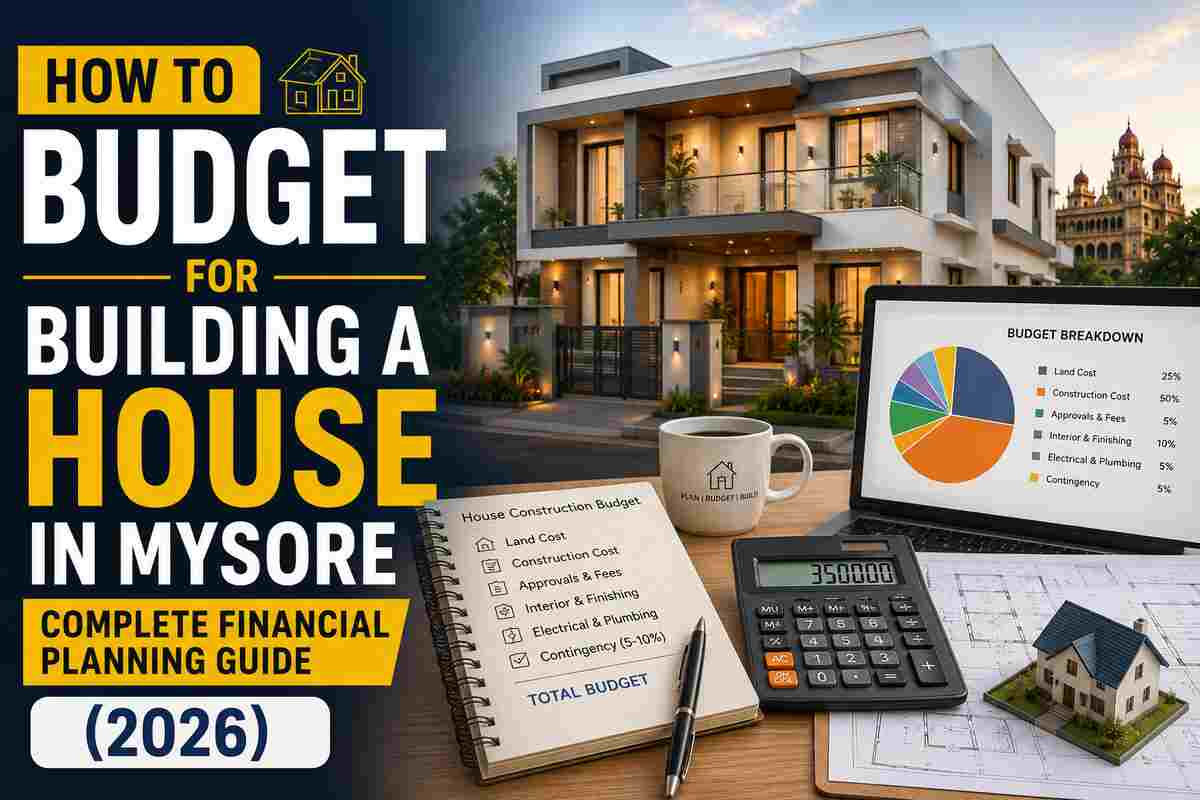
How to Budget for Building a House in Mysore: Complete Financial Planning Guide (2026)
Most families who build a home in Mysore do it once.
It is, for the vast majority, the single largest financial decision of their lives. Larger than a car, larger than a wedding, often larger than every other purchase combined. Years of savings, sometimes a significant loan, and a great deal of emotional investment all converge on one plot of land and one construction project.
And yet, the financial planning behind it is frequently the least structured part of the entire process.
People research builders carefully. They compare per sq ft rates obsessively. They debate floor plans for weeks. But the actual budget, the complete, honest, all-in financial plan covering not just construction but everything around it, is often assembled loosely, with optimistic assumptions and significant gaps.
This is how families end up in the most stressful situation in home construction: running short of money when the structure is up but the home is not finished. A half-built home with no funds to complete it is a genuinely difficult position, and it is almost always the result of incomplete budgeting, not bad luck.
This guide is the complete financial planning framework for building a house in Mysore in 2026. Not just construction cost, but the entire financial picture, honestly laid out.
The First Principle: Budget for the Total, Not the Construction
The single most common budgeting mistake in home construction is treating the construction cost as the total cost.
It is not. Construction is the largest component, but it is one component of several.
When a builder quotes you ₹2,300 per sq ft and you calculate that your 1,850 sq ft home will cost ₹43 lakhs to build, that ₹43 lakhs is the construction cost. It is not what the project will cost you. The complete project, the amount that actually leaves your bank account before you move in, is meaningfully higher.
The families who budget well start from the total project cost and work backwards. The families who struggle start from the construction cost and discover the rest as they go.
Here is the complete picture of what your budget needs to account for.
The Four Layers of a Home Construction Budget
Layer 1: Land (If Not Already Owned)
If you already own your plot, this layer is complete. If you are still purchasing, this is the largest single number in your budget and varies enormously by locality.
Land cost in Mysore depends almost entirely on location. Established central localities command significantly higher rates than developing peripheral areas. Beyond the land cost itself, budget for registration and stamp duty, approximately 5 to 6.5% of the property value in Karnataka, plus legal verification of title, khata transfer, and brokerage if applicable.
For families who already own ancestral or previously purchased land, this entire layer is zero, which is why building on owned land is significantly more financially achievable than buying and building together.
Layer 2: Pre-Construction Costs
These are the costs incurred before a single brick is laid. They are small relative to construction but they come first, and they are frequently forgotten in initial budgets.
Architectural and structural design fees: ₹60,000 to ₹1.5 lakhs depending on the size and complexity of the home and the architect.
MDA / plan approval fees: ₹35,000 to ₹90,000 depending on built-up area and locality.
Soil testing (if required): ₹10,000 to ₹25,000 for larger or structurally complex projects.
Vastu consultation (if engaged): ₹10,000 to ₹35,000.
Document and legal work: Encumbrance certificate, khata verification, betterment charges if applicable. Variable, but budget ₹20,000 to ₹70,000 to be safe.
Total pre-construction layer for a typical home: approximately ₹1.5 to ₹3.5 lakhs.
Layer 3: Construction Cost
This is the largest layer, the actual building of the home.
At Doddamane Constructions, turnkey construction starts at ₹2,300 per sq ft. This covers the complete home, structure, plastering, flooring, plumbing, electrical, doors, windows, and paint, using ISI-certified materials and proper structural engineering.
Here is the construction cost for common configurations:
| Plot & Configuration | Built-Up Area | Construction Cost |
|---|---|---|
| 30×40 G+1 | ~1,850 sq ft | ₹43 to ₹47 lakhs |
| 30×50 G+1 | ~2,350 sq ft | ₹54 to ₹58 lakhs |
| 40×60 G+1 | ~3,300 sq ft | ₹76 to ₹82 lakhs |
| 30×40 G+2 | ~2,700 sq ft | ₹63 to ₹68 lakhs |
Construction is the layer most people budget for accurately, because it is the number the builder quotes. The gaps appear in the layers around it.
Layer 4: Post-Structure and Finishing Costs
These are the costs that turn a constructed building into a livable home. Some are included in a turnkey contract. Many are not. This is the layer where budgets most commonly fall short.
Compound wall and gate: ₹1.8 to ₹4 lakhs depending on plot perimeter.
Borewell: ₹80,000 to ₹1.5 lakhs depending on depth.
BESCOM electrical connection and deposit: ₹50,000 to ₹90,000.
Modular kitchen: ₹1.5 to ₹3.5 lakhs.
Wardrobes and built-in storage: ₹90,000 to ₹2 lakhs.
Light fixtures and ceiling fans: ₹50,000 to ₹1.5 lakhs. Wiring points are included in construction; the fixtures themselves are not.
Window grills and safety railings: ₹50,000 to ₹1.2 lakhs.
Curtains, blinds, and basic furnishing: Variable. Budget at least ₹1 lakh for essentials.
Premium upgrades if chosen: Feature staircase, false ceilings, designer elevation, premium flooring. Each adds cost as covered in our cost articles.
This layer typically adds 15 to 25% on top of the construction cost. On a ₹45 lakh construction, that is ₹7 to ₹11 lakhs of additional spending to reach a move-in-ready home.
The Complete Budget: A Realistic Example
Let us put all four layers together for the most common scenario, a family that owns their 30×40 plot and is building a G+1 home in Mysore in 2026.
| Layer | Item | Cost |
|---|---|---|
| Pre-construction | Design, approvals, documentation | ₹2 to ₹3 lakhs |
| Construction | G+1 home, 1,850 sq ft at ₹2,400/sq ft | ₹44 to ₹46 lakhs |
| Finishing | Compound wall, borewell, BESCOM | ₹3.5 to ₹5 lakhs |
| Finishing | Modular kitchen, wardrobes | ₹2.5 to ₹4 lakhs |
| Finishing | Fixtures, grills, basic furnishing | ₹2 to ₹3.5 lakhs |
| Subtotal | ₹54 to ₹61.5 lakhs | |
| Contingency | 10% buffer (see below) | ₹5.5 to ₹6 lakhs |
| Total Project Budget | ₹60 to ₹67 lakhs |
This is the honest, complete number. A family planning to build a G+1 home on an owned 30×40 plot in Mysore should plan for a total project budget of approximately ₹60 to ₹67 lakhs to reach a fully finished, move-in-ready home.
If your available funds are ₹45 lakhs and you have planned only for construction, you are ₹15 to ₹22 lakhs short of a finished home, and that gap is exactly where construction projects stall.
The Contingency Buffer: The Most Important Line in Your Budget
Notice the contingency line in the table above. This is the single most important and most frequently omitted item in a home construction budget.
A contingency buffer is a reserve, typically 10% of your total project cost, set aside specifically for the unexpected. And in construction, the unexpected is not a possibility. It is a certainty. The only question is its size.
Where contingencies arise:
Material price increases. Steel and cement prices fluctuate. A project that takes 10 months may see material costs rise partway through. A fixed-rate turnkey contract protects you from much of this, but not every cost is fixed.
Design changes you make. Almost every family changes something mid-construction. An upgraded flooring choice, an additional bathroom, a better staircase, a design detail that looks better in reality than on paper. Each change costs money.
Site conditions. Occasionally, soil conditions require additional foundation work, or a borewell needs to go deeper than expected, or a site needs more levelling than anticipated.
The things you did not think of. There is always something. A boundary dispute that needs resolution, a tree that needs removal, an additional electrical requirement.
A family that budgets ₹60 lakhs with no contingency and hits ₹64 lakhs in actual costs is in a stressful position. A family that budgets ₹60 lakhs plus a ₹6 lakh contingency and hits ₹64 lakhs simply uses part of their buffer and finishes comfortably.
Build the contingency in from the start. If you do not use it, it becomes your first furnishing or landscaping fund. If you do use it, it is the difference between finishing your home calmly and finishing it under financial stress.
Financing: How Families Fund Construction in Mysore
Most families building in Mysore use some combination of three funding sources.
Personal savings. The foundation of most home construction budgets. The healthiest projects are funded primarily through savings with a loan supplementing rather than dominating.
Home construction loan. Distinct from a home purchase loan. A construction loan is disbursed in stages as construction progresses, rather than as a single lump sum. Banks and housing finance companies in Mysore offer construction loans typically covering up to 75 to 80% of the construction cost, disbursed against milestone completion.
Plot-plus-construction loan. For families buying land and building together, some lenders offer a combined loan covering both the plot purchase and the construction.
A few honest points about construction loans worth understanding before you commit.
The loan is disbursed in tranches tied to construction stages, not upfront. This means your initial stages must be funded by your own contribution, with the loan kicking in as construction progresses. Plan your cash flow accordingly.
Interest during construction is typically charged only on the amount disbursed so far, not the full sanctioned amount. This is called pre-EMI interest. Your full EMI begins after the final disbursement.
The bank will require the sanctioned MDA building plan, the construction agreement, and the builder’s details as part of loan processing. A home built without proper approval cannot be financed, another reason approvals matter.
We are not financial advisors and this is not financial advice. Speak to your bank or a qualified loan advisor about the specific product and terms that suit your situation. What we can tell you from the construction side is that lenders strongly prefer projects with proper approvals, a clear construction agreement, and an established builder, all of which make loan processing smoother.
Cash Flow Timing: Matching Money to Milestones
A budget is not just about how much. It is about when.
Construction payments in a turnkey project are milestone-based. You pay as stages complete, not all upfront. This is a significant advantage for cash flow planning because it means your money goes out in phases matched to visible progress.
A typical milestone payment structure looks like this:
| Stage | Approximate % of Construction Cost |
|---|---|
| Advance on signing | 10% |
| Foundation and plinth complete | 15% |
| Ground floor structure and slab | 15% |
| First floor walls and slab | 15% |
| Roof slab and brickwork complete | 15% |
| Plastering, plumbing, electrical | 15% |
| Finishing, paint, and handover | 15% |
This structure lets you plan your cash flow and, if using a construction loan, align the loan disbursement with the payment milestones.
The key cash flow insight: your largest outflows are spread across the construction period, not concentrated at the start. This means you do not need the entire construction budget available on day one. You need the advance plus your own contribution for the early stages, with subsequent funds, whether savings or loan disbursements, available as the milestones arrive.
Plan your finances around this rhythm. Know which milestone each payment is tied to and ensure the funds are available when that stage completes. A two-week delay in arranging a milestone payment can pause your project for far longer.
A Practical Budgeting Process, Step by Step
Here is the sequence we recommend to every family before they begin construction.
Step 1: Establish your total available funds. Savings, plus the loan amount you can comfortably service, plus any other sources. This is your ceiling.
Step 2: Work backwards to your construction budget. From your total available funds, subtract the pre-construction costs, the finishing costs, and the 10% contingency. What remains is your realistic construction budget.
Step 3: Let your construction budget determine your home size, not the other way around. If your realistic construction budget supports a 1,850 sq ft G+1 home, build that well. Do not stretch to a 2,700 sq ft G+2 that leaves no room for finishing or contingency. A smaller home built completely and comfortably is a far better outcome than a larger home you cannot afford to finish.
Step 4: Get an itemised estimate, not a per sq ft number. Ask your builder for a detailed, stage-wise, itemised estimate. This is the document that lets you budget accurately and identify exactly where your money goes.
Step 5: Confirm the milestone payment schedule. Know what triggers each payment and ensure your cash flow aligns.
Step 6: Set aside the contingency before you start, and do not touch it for anything except genuine contingencies.
The Honest Advice We Give Every Family
The most important financial advice we can offer about building a home is this: build within your means, completely, rather than beyond your means, incompletely.
A family that builds a well-finished, complete 1,850 sq ft home that they can afford, with every room finished, every fitting in place, a contingency intact, and no financial stress, has a far better outcome than a family that builds a larger home they cannot finish, living for years in a partially complete house while they save for the next stage.
We have a starting rate of ₹2,300 per sq ft and we do not go below it, because building responsibly has a real cost. But we would always rather help a family build a smaller home properly than encourage them to overcommit to a larger one. The size of the home matters far less, in the end, than the quality of how it is built and the peace of mind with which the family moves in.
Budget honestly. Build within it. Keep the contingency. Finish completely.
That is how a home becomes a Dodda Mane. Not through its square footage, but through the calm and pride with which a family steps into it, fully finished, fully theirs.
Frequently Asked Questions
How much money do I need to build a house in Mysore in 2026?
For a complete, move-in-ready G+1 home on an owned 30×40 plot, you should budget approximately ₹60 to ₹67 lakhs total, including construction at ₹2,300+ per sq ft, pre-construction costs, finishing items like compound wall, borewell, modular kitchen, and a 10% contingency buffer. The construction cost alone is approximately ₹43 to ₹47 lakhs, but the complete project including everything is meaningfully higher.
What costs are forgotten when budgeting for house construction in Mysore?
The most commonly forgotten costs are compound wall and gate, borewell, BESCOM electrical connection, modular kitchen, wardrobes, light fixtures and fans, window grills, MDA approval fees, and the contingency buffer. These typically add 15 to 25% on top of the construction cost. Families who budget only for construction are usually ₹10 to ₹20 lakhs short of a finished home.
How much contingency should I budget for home construction?
A contingency buffer of 10% of your total project cost is recommended. Construction projects almost always encounter unexpected costs, material price changes, design upgrades, site conditions. A 10% buffer means these are absorbed comfortably rather than causing the project to stall. If unused, the contingency becomes your furnishing or landscaping fund.
Can I get a home loan to build a house in Mysore?
Yes. Banks and housing finance companies offer construction loans covering up to 75 to 80% of the construction cost, disbursed in stages as construction progresses rather than as a lump sum. The lender will require the sanctioned MDA building plan, the construction agreement, and builder details. A home built without proper approval cannot be financed. Speak to your bank for specific terms.
How are construction payments structured in Mysore?
Turnkey construction payments are milestone-based. You pay as stages complete, not upfront. A typical structure is 10% advance, then approximately 15% at each major milestone: foundation, ground floor slab, first floor slab, roof slab, plastering and services, and final finishing. This spreads your outflows across the construction period and lets you align loan disbursements with milestones.
Should I build a bigger house or finish a smaller one completely?
Build within your means, completely. A well-finished smaller home with every room complete, a contingency intact, and no financial stress is a far better outcome than a larger home you cannot afford to finish. A partially complete house that stalls for lack of funds is the most stressful situation in home construction. Let your realistic budget determine your home size, not the other way around.
What is the difference between construction cost and total project cost?
Construction cost is what the builder charges to build the home, structure, finishing, plumbing, electrical, paint. Total project cost includes everything else: land if not owned, design and approval fees, compound wall, borewell, BESCOM connection, modular kitchen, wardrobes, fixtures, and contingency. The total project cost is typically 20 to 30% higher than the construction cost alone.
Also useful:
→ Construction Cost Per Sq Ft in Mysore in 2026
→ What It Really Costs to Build a 30×40 House in Mysore
→ 40×60 House Construction Cost in Mysore (2026)
→ What to Check in a Construction Agreement Before Signing
→ How to Choose a Builder in Mysore: 7 Questions to Ask Before You Sign
Planning your home construction budget in Mysore and want an honest, itemised estimate, not just a per sq ft number, so you can plan your finances completely? Talk to our team.


One Comment