How to Choose a Builder in Mysore — 7 Questions to Ask Before You Sign

Choosing a builder is one of the most consequential decisions a family makes.
Not because it determines how your home looks. But because it determines how your home performs — structurally, functionally, and financially — for the next thirty to fifty years.
In Mysore’s residential construction market in 2026, there are hundreds of builders operating across the city. Some are excellent. Some are adequate. Some will take your advance, begin work with visible enthusiasm, and gradually reveal — through missed timelines, material substitutions, and disappearing supervision — that their promises and their practice are two different things.
The problem is that on the day you first meet them, they all sound similar. Professional. Experienced. Committed. Transparent.
So how do you tell the difference?
Not from brochures. Not from Instagram pages. Not from the smoothness of the first meeting.
You tell the difference by asking the right questions — and knowing what honest answers actually sound like.
At Doddamane Constructions, we have been on the receiving end of these conversations for years. We have sat across the table from families who came to us after difficult experiences with previous builders. We have heard the same patterns repeated — the low quote that grew, the supervision that vanished, the materials that were never what was promised.
This article is our honest attempt to give you the tools to avoid those outcomes — whether you build with us or with someone else.
Before the Questions: The Right Mindset Going In
Most homeowners approach a builder meeting as a negotiation. They want the best price, the fastest timeline, and the most features.
That is understandable. But it is the wrong frame.
The more useful frame is this: you are not choosing someone to give you a price. You are choosing someone to take responsibility for the most expensive thing your family will ever own.
With that in mind, the goal of every builder conversation is not to get a number. It is to assess accountability. Does this person — and this company — have the systems, the standards, and the character to be responsible for your home when things get difficult?
Because things always get difficult somewhere in a construction project. A delivery arrives with the wrong material. A subcontractor makes an error in a structural pour. Rain delays a plastering stage. What separates a good builder from a bad one is not whether these things happen. It is how they are handled when they do.
The seven questions below are designed to reveal that.
Question 1: Can I Visit a Home You Have Completed in the Last Two Years?
This is the most important question on this list. Ask it first.
Not a site under construction. Not a 3D render. Not photos on a phone. A completed home — handed over to a family who is now living in it.
Walking through a finished home tells you things no amount of conversation can. You will see the quality of the plaster finish on the walls. You will notice whether the flooring tiles are evenly laid or show lippage at the edges. You will observe whether the electrical points are placed thoughtfully or wherever was convenient. You will look at the doors and see whether they hang straight and close cleanly.
More importantly, the family living there will tell you the truth. Not just about the quality of the construction — but about the process. Was the builder responsive when problems were raised? Were there surprises in the final billing? Was the timeline met? Would they build with the same company again?
What a confident, accountable builder says: Yes. Here are two or three recent projects. Let me give you the homeowners’ numbers directly.
What should concern you: Reluctance, deflection, or an offer to show photos instead. A builder who has delivered well has no reason to hide the evidence.
Question 2: What Brands of Steel and Cement Will You Use — and Will You Put That in the Agreement?
The materials inside your walls are invisible once construction is complete. This makes them the easiest place for a builder to reduce quality without your knowledge.
The difference between ISI-certified FE500 grade steel from a brand like SK Super TMT, Turbo, or Meenakshi — and unbranded, uncertified steel from a local supplier — is not visible on site. It is visible in how your structure behaves under load over twenty years.
The difference between Ultratech 53 grade cement and an unbranded 33 grade alternative is not visible in the mix. It is visible in the compressive strength test that you will never commission and the cracks that may appear in your columns a decade later.
Ask every builder to name the specific brands of steel, cement, sand, plumbing pipes, electrical wire, and sanitary fittings they will use. Then ask them to include those brand names in the written construction agreement.
A builder who resists this request is leaving themselves room to substitute. A builder who agrees without hesitation is the one who intends to use what they quoted.
What a confident, accountable builder says: Here is our standard specification sheet. These brands are what we always use and yes, we will include them in the agreement.
What should concern you: Vague answers like “we use quality materials” or “branded items as per availability.” Availability is how substitution happens.
Question 3: Is Your Quote Turnkey — or Does It Cover Structure Only?
This is the question that explains most of the wide variation in construction quotes you will receive in Mysore.
A quote of ₹1,800 per sq ft and a quote of ₹2,300 per sq ft are not necessarily two prices for the same home. They may be two prices for completely different scopes of work.
A structure-only or civil quote typically covers foundation, columns, beams, brick walls, and RCC slabs. That is the skeleton of your home — walls up, roof on. It does not include flooring, plumbing fittings, electrical completion, paint, doors, windows, or any of the finishing that makes a structure into a livable home.
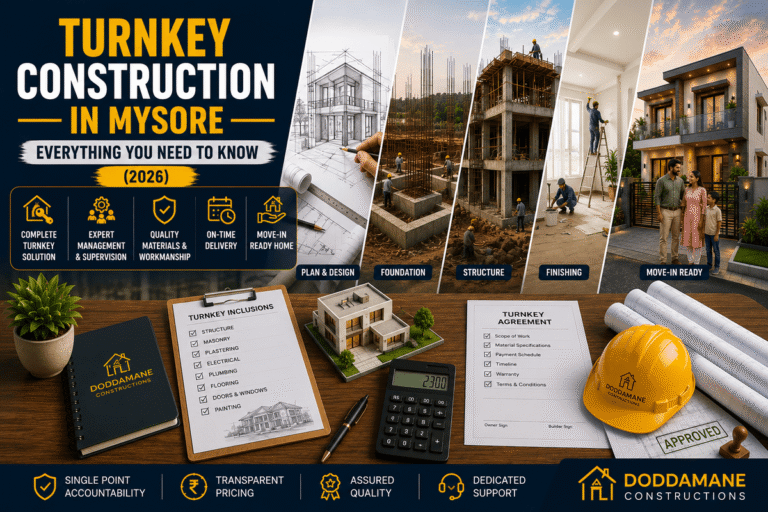
A turnkey quote covers everything from foundation to final handover — including all finishing, all fittings, and all systems. You move in. Nothing is pending.
The gap between these two scopes is typically ₹600 to ₹900 per sq ft. On a 1,800 sq ft G+1 home, that is ₹10 to ₹16 lakhs of additional cost that was not visible in the initial quote.
Before you compare any two builders’ numbers, make sure you are comparing the same thing.
What a confident, accountable builder says: Our quote is fully turnkey. Here is what is specifically included and here is the list of exclusions — approvals, borewell, compound wall, modular kitchen.
What should concern you: A quote that does not clearly state what is included and what is not. If a builder cannot or will not define their scope in writing, the undefined items will become disputes later.
Question 4: How Will You Communicate With Me During Construction?
A home takes eight to twelve months to build. During that time, your money is being spent every day on a site you may or may not be able to visit regularly.
How you stay informed about what is happening on that site — and how quickly problems are escalated to you — is a direct function of the builder’s communication systems.
The standard in Mysore’s better construction companies in 2026 is daily site updates — photographs of the day’s progress, notes on what was completed, and flags on anything requiring a client decision. These are typically shared via WhatsApp at the end of each working day.
Beyond daily updates, documentation matters. Are drawings, invoices, and material receipts shared with you throughout the project — or do you only see the final bill? Is there a shared folder where you can access all project documents at any time?
Ask this question specifically. The answer tells you how the builder thinks about client relationships — as a transaction to be completed or as an ongoing accountability to be honoured.
What a confident, accountable builder says: We send daily WhatsApp updates with site photos every evening. All drawings and invoices are in a shared Google Drive you can access anytime. You will always know exactly what is happening on your site.
What should concern you: A builder who says updates happen “when needed” or “when there is something to share.” A home under construction always has something to share. Daily communication is not an extra — it is the baseline.
Question 5: Who Is on My Site Every Day?
This question cuts to the heart of what separates professional construction management from contractor-led work.
Every builder you speak to will tell you their team is experienced and qualified. What they will not all tell you is how much of that experience is actually present on your site on a daily basis.
The pattern in much of Mysore’s construction market is this. The business owner meets you, makes promises, and takes your advance. Then your project is handed to a site supervisor — often a young, relatively inexperienced person — who manages the day-to-day. The business owner may visit once a week. Or once a fortnight. Or when you call to ask why something looks wrong.
In that model, quality control depends entirely on the site supervisor’s judgement. Concrete mix ratios, curing duration, steel placement, plumbing slope — all of these things require a knowledgeable person to verify them as they happen. Once concrete has been poured, errors in it cannot be corrected without demolition.
Ask exactly who will be on your site every day. What is their qualification? How many other projects are they managing simultaneously? How often will the business owner or a senior engineer visit and inspect the work?
What a confident, accountable builder says: A qualified site engineer is present at our sites every working day. Our founder visits each project personally at every key structural milestone. We manage a limited number of projects simultaneously so that no site is under-supervised.
What should concern you: Vague references to “our team” without specific answers about who is actually present and how often. Supervision is not a nice-to-have — it is how quality is enforced.
Question 6: What Happens If the Project Is Delayed or Something Goes Wrong?
Most builder conversations focus on the best-case scenario. The project starts on time, proceeds smoothly, and is handed over on the date promised.
Ask what happens when that is not the case.
Construction projects encounter delays. Rain, material supply disruptions, labour availability, approval timelines — these are real factors. The question is not whether delays can happen. It is who bears the consequences when they do.
Ask for a clear timeline with milestones and the payment schedule linked to those milestones. If a milestone is not completed, the associated payment is not due. This structure gives you genuine financial leverage and gives the builder a genuine incentive to maintain pace.
Ask also about defects after handover. If a plumbing joint inside a wall begins leaking three months after you move in, who pays to open the wall and fix it? What warranty does the builder provide on their workmanship, and is that warranty in writing?
What a confident, accountable builder says: Our payment schedule is milestone-based — you pay when we deliver each stage. We provide a workmanship warranty in writing. Site security and material loss during construction are our responsibility, not yours.
What should concern you: Any builder who is vague about accountability after handover, or who frames the warranty as a goodwill gesture rather than a written commitment. Goodwill is not enforceable. A written warranty is.
Question 7: Can I See an Itemised Estimate — Not Just a Per Sq Ft Rate?
A per sq ft rate is a summary. An itemised estimate is the truth.
An itemised construction estimate breaks down the cost of your home stage by stage and component by component — civil structure, plastering, flooring, plumbing, electrical, painting, and finishing. Each line item names what is included, what brand or specification is being used, and what it costs.
Asking for an itemised estimate does two things. First, it gives you a genuine basis for comparing quotes from different builders — because you can see exactly where the numbers differ rather than trying to compare summary totals. Second, it reveals how thoroughly a builder has actually thought about your project before quoting it.
A builder who hands you an itemised estimate has done the work of planning your home before you have paid them anything. That thoroughness is itself a signal of how they will manage the project once it begins.
A builder who can only give you a per sq ft rate and tells you the details will be worked out later is asking you to make a large financial commitment based on incomplete information. That imbalance tends to remain throughout the project.
What a confident, accountable builder says: Here is a detailed estimate broken down by stage and component. Every item has a specification and a cost. Ask us about anything that is unclear.
What should concern you: Reluctance to provide detail before you sign. The information asymmetry that begins at the quote stage tends to continue throughout construction.
What the Right Builder Actually Looks Like
When you have asked these seven questions across multiple builders, you will notice a pattern.
The builders who answer confidently and specifically — with references you can call, material lists they will put in writing, and communication systems they can describe in detail — are the ones who have nothing to hide. Their confidence comes from the fact that what they say and what they do are the same thing.
The builders who deflect, generalise, or make promises they frame as trust-based rather than document-based are the ones whose accountability is most likely to diminish once your advance is paid.
Building a home in Mysore is not a small decision. For most families it represents years of savings and decades of living.
You deserve a builder who treats it that way.
A Summary Checklist
Before signing with any builder in Mysore, confirm the following:
- You have visited at least one completed project
- You have spoken directly to a previous client
- Material brands are specified in the written agreement
- The quote is clearly turnkey with explicit inclusions and exclusions
- Daily communication and documentation processes are defined
- A qualified person is present on site every working day
- Payments are milestone-based, not time-based
- A written workmanship warranty is included in the agreement
If all eight of these are in place, you have the foundation of an accountable construction relationship.
If any of them are absent, you know exactly what question to go back and ask.
Frequently Asked Questions
How do I choose the best construction company in Mysore? The best construction company in Mysore for your home is the one that can demonstrate accountability at every stage — not just promise it. Ask to visit completed projects, speak to previous clients, and request a written agreement that specifies material brands, milestone-based payments, and a workmanship warranty. These elements separate professional builders from those who rely on trust without backing it with documentation.
What should I check before signing a construction agreement in Mysore? Before signing any construction agreement in Mysore, verify that it includes: specific material brand names, a clear definition of what is turnkey and what is excluded, a milestone-based payment schedule, a timeline with stage-wise completion dates, a post-handover warranty period, and a defined communication process during construction.
Why do builder quotes vary so much in Mysore? Quotes vary because builders are pricing different scopes, different material standards, and different supervision levels. A low per sq ft rate typically reflects a structure-only quote that excludes finishing, or assumes unbranded materials, or factors in minimal site supervision. Before comparing quotes, confirm that every builder is pricing the same completed home to the same material specification.
What is a reasonable construction cost per sq ft in Mysore in 2026? Responsible, complete turnkey construction in Mysore in 2026 costs a minimum of ₹2,300 per sq ft. This covers foundation through final paint using ISI-certified and branded materials with daily supervision. Quotes below this level for a complete turnkey home require scrutiny about where the difference is being recovered.
What is milestone-based payment in construction? Milestone-based payment means your payments are linked to specific stages of construction completion — foundation done, ground floor slab cast, first floor complete, and so on. You pay when the work is done, not on a calendar schedule. This structure protects you financially and gives the builder a clear incentive to maintain construction pace.
How do I check a builder’s credibility in Mysore? Ask for references from homeowners whose projects were completed in the last two years and call them directly. Visit a completed project in person. Check Google reviews and Justdial ratings. Ask the builder to specify materials in writing before you sign. A builder with genuine credibility will support every one of these requests without hesitation.
Also useful: → Construction Cost Per Sq Ft in Mysore in 2026 — The Complete, Honest Guide → What It Really Costs to Build a 30×40 House in Mysore → Turnkey vs Labour Contract — Which Is Right for Your Home?
If you are shortlisting builders in Mysore and would like an honest conversation — about your plot, your budget, and what responsible construction actually looks like — we are ready when you are.