G+1 vs G+2 in Mysore — Which Should You Build on Your Plot? (2026 Guide)
You have the plot. You know roughly what you want to build. But somewhere between the first conversation with an architect and the first meeting with a builder, a question comes up that nobody gives you a straight answer to.
Should I build G+1 or G+2?
It sounds like a simple question. One floor more or one floor less. But the decision has consequences that run through your budget, your structural costs, your approval process, your construction timeline, and — most importantly — how your family actually lives in the home for the next thirty years.
This article gives you the honest framework to make that decision. Not a generic answer that applies to every plot everywhere. A specific, practical guide for homeowners building in Mysore in 2026.
What G+1 and G+2 Actually Mean
For anyone unfamiliar with the terminology used in Mysore’s construction market:
G+0 means ground floor only. A single-storey home with no upper floor.
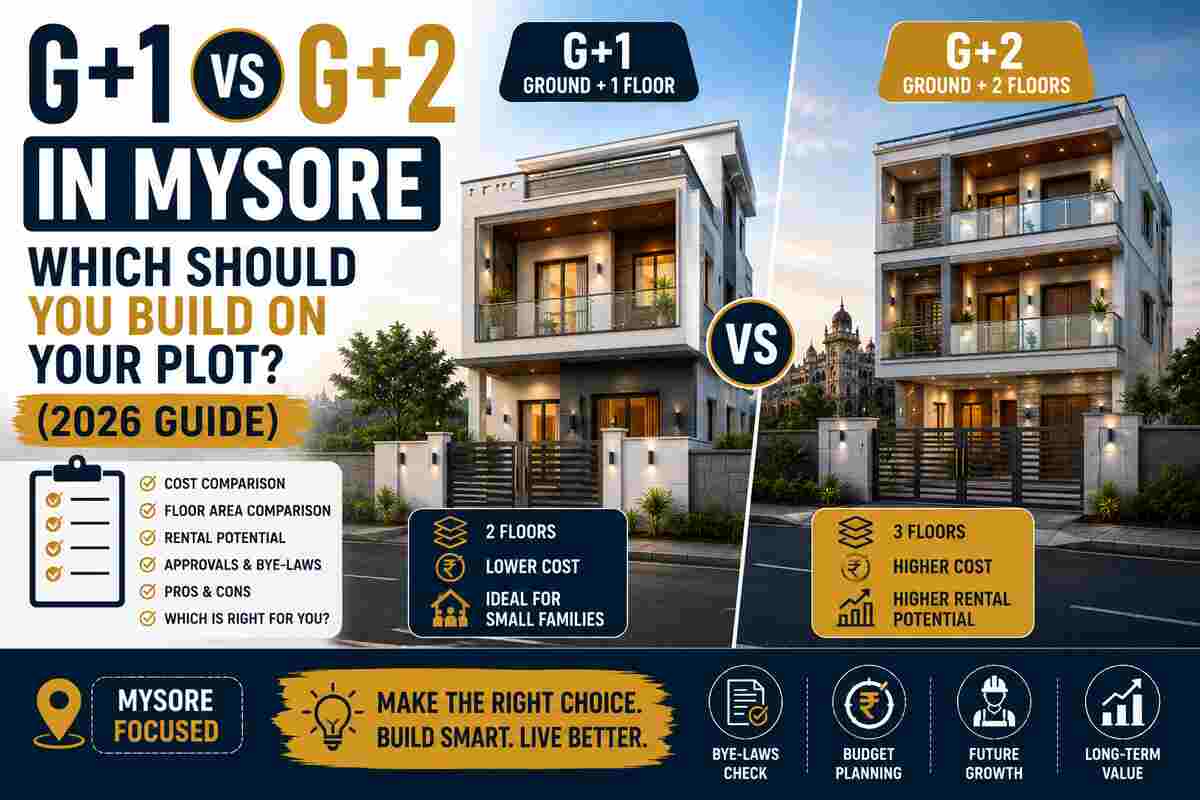
G+1 means ground floor plus one upper floor. Two levels in total.
G+2 means ground floor plus two upper floors. Three levels in total.
The G stands for ground. The number tells you how many floors are built above it.
When a structural engineer designs your home, the foundation, column sizes, beam dimensions, and slab specifications are all calculated based on the total number of floors the structure will eventually carry. This is why the decision matters so much — the structural design, and therefore a meaningful portion of the cost, is determined before construction begins.
The First Question — Does Your Plot and Layout Actually Permit G+2?
Before anything else, answer this question.
Not every plot in Mysore permits three-floor residential construction. MUDA building regulations specify Floor Space Index — FSI — and height restrictions that vary by plot size, road width, and the specific layout in which your plot sits.
As a general guide for Mysore:
Most residential plots in MUDA-approved layouts permit G+1 without any special consideration. This is the standard residential construction height in most Mysore localities.
G+2 is permitted on many plots but depends on the road width adjacent to the plot, the FSI applicable to your specific layout, and the plot size. Plots on wider roads typically have more permissive height regulations. Plots in layouts with specific height restrictions — some older Mysore layouts have these — may limit you to G+1 even if you want to go higher.
G+3 and above require specific permissions and are generally only available on larger plots on main roads in commercial or mixed-use zones.
The practical action before making any decision: ask your architect to verify the permissible height and FSI for your specific plot number and layout. Do not assume. The MUDA regulations are specific to each layout, and building beyond the permitted height creates legal complications that are expensive and stressful to resolve after construction has begun.
What Each Configuration Costs in Mysore in 2026
Let us put real numbers to each option so the cost difference is visible before we discuss anything else.
These figures are based on responsible construction starting at ₹2,300 per sq ft — the minimum for a complete, quality turnkey home in Mysore in 2026 using ISI-certified materials and proper structural engineering.
On a 30×40 Plot
| Configuration | Built-Up Area | Construction Cost |
|---|---|---|
| G+0 Single Floor | ~900 sq ft | ₹20 – ₹22 lakhs |
| G+1 Two Floors | ~1,850 sq ft | ₹43 – ₹47 lakhs |
| G+2 Three Floors | ~2,700 sq ft | ₹63 – ₹68 lakhs |
On a 40×60 Plot
| Configuration | Built-Up Area | Construction Cost |
|---|---|---|
| G+0 Single Floor | ~1,700 sq ft | ₹39 – ₹42 lakhs |
| G+1 Two Floors | ~3,300 sq ft | ₹76 – ₹82 lakhs |
| G+2 Three Floors | ~4,800 sq ft | ₹1.10 – ₹1.18 crore |
The cost difference between G+1 and G+2 on a 30×40 plot is approximately ₹20 – ₹21 lakhs for the additional floor.
On a 40×60 plot it is approximately ₹34 – ₹36 lakhs for the third floor.
These are not small numbers. The decision to add a floor is a decision to spend an additional ₹20 to ₹36 lakhs. That money needs to serve a clear purpose — family living space, rental income, or future flexibility. If it does not serve a clear purpose for your family, it is a significant cost without a corresponding benefit.
Why G+2 Costs Significantly More Than Just One Extra Floor
This surprises many homeowners. They assume that adding one more floor adds roughly one-third to the cost of a G+1 home. In practice, a G+2 home costs more than that proportional calculation suggests.
Here is why.
Foundation and structural design are recalculated for three floors. A G+1 home is designed to carry two levels of load. A G+2 home must carry three. This requires larger column cross-sections, deeper foundations, heavier beam sizes, and more steel per column. These structural upgrades affect every column and foundation point in the building — not just the third floor.
The additional steel and concrete required for a G+2 structure over a G+1 structure on the same plot is typically 15 to 20% more across the entire structural frame — not just the top floor. This cost is borne from the foundation upward.
The staircase becomes more complex and space-consuming. A staircase serving three floors requires more horizontal space than one serving two floors. In a compact 30×40 home, the additional staircase space takes away from usable floor area at every level.
Services — plumbing, electrical, drainage — are more complex. Vertical runs of pipe, wiring, and drainage extend further. More junction points. More connection complexity. More potential failure points if not executed well.
Construction timeline is longer. A G+2 home takes three to four months longer than a G+1 home on the same plot. Every additional floor adds approximately eight to twelve weeks — the time required for structural work and curing at each level. This means additional months of construction loan interest if you are using financing.
The Five Factors That Should Drive Your Decision
Factor 1 — Current and Future Family Size
The most important question is how many people will live in this home over the next fifteen to twenty years.
A G+1 home on a 30×40 plot gives you approximately 1,850 sq ft across two floors. That is typically three to four bedrooms — enough for a couple with children, or a small extended family of five to six people.
If your household is currently four people and is unlikely to grow significantly, a G+1 is almost certainly sufficient. The additional floor of a G+2 may never be fully used, and unused space is not an asset — it is a maintenance cost.
If your household includes or will include three generations — parents, children, and grandparents — or if you anticipate children who will stay in the home as adults, a G+2 provides the space to accommodate that without everyone feeling crowded.
Honest guidance: Build for the household you will have in ten years, not the household you might theoretically have in thirty. Life changes in ways you cannot predict — but spending an additional ₹20 lakhs on floor space that sits empty for the next decade is a decision that does not serve most families.
Factor 2 — Rental Income
This is the clearest financial justification for G+2 in Mysore.
If one floor of a G+2 home is rented out — typically the ground floor or an independent flat carved from the upper floor — the rental income can service a meaningful portion of the additional construction cost over time.
In Mysore’s residential rental market in 2026, a well-designed independent 2BHK unit in localities like JP Nagar, Srirampura, or Kuvempunagar commands between ₹12,000 and ₹20,000 per month depending on the size, finish level, and specific location.
At ₹15,000 per month, a rental unit generates ₹1.8 lakhs per year. The additional construction cost of G+2 over G+1 on a 30×40 plot is approximately ₹20 lakhs. That is an eleven-year payback on the additional construction cost from rental income alone — not accounting for the capital appreciation of the built asset.
For families where one generation wants to live independently from another — parents on one floor, children on another — G+2 also functions as a dual-household home without the cost of purchasing two separate properties.
Honest guidance: If rental income or multigenerational independent living is a clear purpose for the third floor, G+2 has a strong financial case. If the third floor is speculative — you might rent it someday, or someone might move in eventually — that is a weaker justification for the additional upfront cost.
Factor 3 — Plot Size and Design Efficiency
The case for G+2 is much stronger on a 40×60 plot than on a 30×40 plot.
On a 40×60 plot, a G+2 home gives you approximately 4,800 sq ft of built-up area. Distributed intelligently across three floors, this creates genuinely spacious living — large bedrooms, dedicated study or office space, a proper family room on one floor while a formal living room occupies another. The space is large enough that good design can make every room feel generous.
On a 30×40 plot, a G+2 home gives you approximately 2,700 sq ft across three floors — roughly 900 sq ft per floor. Three floors of 900 sq ft each is functional but not spacious. The staircase, bathroom, and circulation space consume a significant percentage of each floor’s area. The rooms that remain are practical but modest.
For many 30×40 homeowners, a well-designed G+1 home of 1,850 sq ft with two generous floors will feel and function better than a G+2 of 2,700 sq ft spread across three tight floors.
Honest guidance: On a 30×40 plot, prioritise quality and liveability of two floors over quantity of three. On a 40×60 plot, G+2 can genuinely be the better choice if the family size and purpose justify it.
Factor 4 — Budget and Financial Comfort
This is the factor most homeowners underweigh during the planning stage.
It is easy to say you will build G+2. It is more difficult to manage the financial reality of a construction budget that is ₹20 to ₹36 lakhs higher than G+1 — particularly if you are financing part of the construction through a home loan.
Additional construction cost means additional loan principal. Additional loan principal means higher EMI. Higher EMI for a longer period while you are also managing the costs of living and the miscellaneous expenses that always accompany a construction project.
Before committing to G+2, run the complete financial calculation including loan interest, not just the construction cost. A ₹20 lakh additional cost financed over fifteen years at 8.5% interest costs approximately ₹35 lakhs in total repayments.
Honest guidance: If G+2 requires you to stretch your finances significantly — if it puts you at the limit of comfortable EMI management or leaves you without a financial buffer for the contingencies that inevitably arise during construction — build G+1 well rather than G+2 under financial stress.
A G+1 home built to high standards is a better long-term asset than a G+2 home built with cost compromises at every stage because the budget was too tight.
Factor 5 — Future Flexibility — Can You Add a Floor Later?
This is the question many families ask as a compromise. Build G+1 now. Add the third floor later when the budget allows.
It is possible — but not as straightforward as it sounds.
If your structural design accounts for the additional floor from day one, adding a floor later is technically feasible. The columns and foundations are already sized to carry three floors. The additional floor is a construction project on an existing structure.
If your structural design does not account for the additional floor, adding one later requires a structural assessment — and often structural reinforcement — of the existing frame before additional loads can be placed on it. This is significantly more expensive than building correctly from the start.
The practical action if you are planning to add a floor later: tell your structural engineer before they design the foundation. Ask them to design for G+2 load even though you are only building G+1 now. The additional cost of designing and building the foundation and columns for three floors while constructing two is approximately ₹2 to ₹4 lakhs — far less than the cost of retrofitting a structure that was not designed for it.
Honest guidance: If there is a genuine possibility of adding a floor in the next five to ten years, invest in G+2 structural design upfront even while building G+1 today. If there is no realistic plan to add a floor, design for what you are actually building.
The Decision Framework — How to Choose
Run through these five questions in order. Your answers will lead you to a clear decision.
Question 1: Does your plot and layout actually permit G+2? If no — the decision is made. Build G+1. If yes — continue.
Question 2: Is there a clear, specific purpose for the third floor — rental income, a generation of family, or a home office? If no — the financial case for G+2 is weak. Consider G+1. If yes — continue.
Question 3: Is your plot 40×60 or larger? If no (30×40 or smaller) — strongly consider whether the floor space per level in G+2 is genuinely livable for your family. A well-designed G+1 may serve you better. If yes — G+2 can work very well at this plot size.
Question 4: Can you build G+2 comfortably within your budget without significant financial stretch? If no — build G+1 well. A quality G+1 serves most families better than a stressed G+2. If yes — continue.
Question 5: Do you want to future-proof for adding a floor even if not now? If yes to adding later — invest in G+2 structural design even while building G+1.
What Most Families in Mysore Actually Build — And Why
Based on residential construction patterns in Mysore in 2026, the most common choices break down broadly like this.
On 30×40 plots: The majority of families build G+1. It provides sufficient space for most family configurations, fits comfortably within typical construction budgets, and produces a well-proportioned home at this plot size. G+2 on a 30×40 site is usually chosen specifically for rental income.
On 40×60 plots: The split is more even between G+1 and G+2. Families building for multigenerational living or with rental income as a goal frequently choose G+2. Families building for nuclear family use often find G+1 sufficient and prefer to use the additional budget on quality finishes, elevation design, and outdoor space.
On 20×30 plots: Almost always G+1. The floor plate at this plot size makes G+2 very compact at each level.
A Note on the Structural Decision
Whatever you decide, ensure your structural engineer is told the final floor count before they design anything.
Changing from G+1 to G+2 after the structural drawings are complete requires a complete redesign — with additional fees and potentially a delay in plan approval submission.
Changing after foundation work has begun on a G+1 design is even more complex and expensive.
The structural decision is the one that must be made first and made correctly. Everything else — room layout, finishes, elevation design — can be revised as you go. The structural frame cannot.
Frequently Asked Questions
What is the difference between G+1 and G+2 construction in Mysore? G+1 means a ground floor plus one upper floor — two levels total. G+2 means a ground floor plus two upper floors — three levels total. On a 30×40 plot, a G+1 home has approximately 1,850 sq ft of built-up area. A G+2 home on the same plot has approximately 2,700 sq ft. The additional floor adds approximately ₹20 to ₹21 lakhs to the construction cost at responsible construction standards in Mysore in 2026.
How much does G+2 construction cost in Mysore in 2026? A G+2 home on a 30×40 plot in Mysore costs approximately ₹63 – ₹68 lakhs at ₹2,300 per sq ft for the construction. A G+2 home on a 40×60 plot costs approximately ₹1.10 – ₹1.18 crore. These are construction costs. Total project cost including approvals, compound wall, borewell, kitchen, and interiors adds approximately 15 to 20% on top.
Can I build G+2 on my plot in Mysore? It depends on your specific plot, layout, and road width. MUDA building regulations permit G+2 on many residential plots in Mysore but not all. The permissible height and FSI vary by layout. Ask your architect to verify the maximum permissible floors for your specific plot number and layout before making any decision.
Is G+1 better than G+2 for a 30×40 plot in Mysore? For most families, yes. A well-designed G+1 on a 30×40 plot gives approximately 1,850 sq ft across two spacious floors. A G+2 gives 2,700 sq ft across three more compact floors. For families without a specific need for the third floor — rental income or multigenerational independent living — a quality G+1 typically provides better liveability than a stretched G+2.
Can I add a floor later if I build G+1 now? Yes — if your structural design accounts for the additional floor from day one. Tell your structural engineer during the design phase that you may add a floor in the future. They will design the foundation and columns to carry G+2 loads even while you only build G+1. The additional design and structural cost upfront is approximately ₹2 to ₹4 lakhs — significantly less than retrofitting a structure not originally designed for the extra load.
How long does G+2 construction take in Mysore? A G+2 home takes approximately 12 to 14 months on a 30×40 plot. A G+1 takes 9 to 11 months. The additional floor adds approximately three to four months to the construction timeline — the time required for structural work and curing at the third level.
What is the rental income potential from a G+2 home in Mysore? A well-designed independent 2BHK unit in residential localities like JP Nagar, Srirampura, or Kuvempunagar commands ₹12,000 to ₹20,000 per month in Mysore in 2026 depending on size, finish, and location. At ₹15,000 per month, the additional construction cost of the third floor on a 30×40 home is recovered in approximately eleven years from rental income alone — not accounting for capital appreciation.
Also useful: → What It Really Costs to Build a 30×40 House in Mysore → 40×60 House Construction Cost in Mysore (2026) → How Long Does It Take to Build a House in Mysore? → How to Choose a Builder in Mysore — 7 Questions to Ask Before You Sign → Construction Cost Per Sq Ft in Mysore in 2026
Deciding between G+1 and G+2 for your plot in Mysore and want an honest conversation about what makes sense for your family, your budget, and your site? We are happy to help you think it through.
[Talk to Doddamane Constructions →] (Link to contact page)