Builders and Developers in Mysore – What’s the Difference, and Which Do You Actually Need? (2026)
Highlights
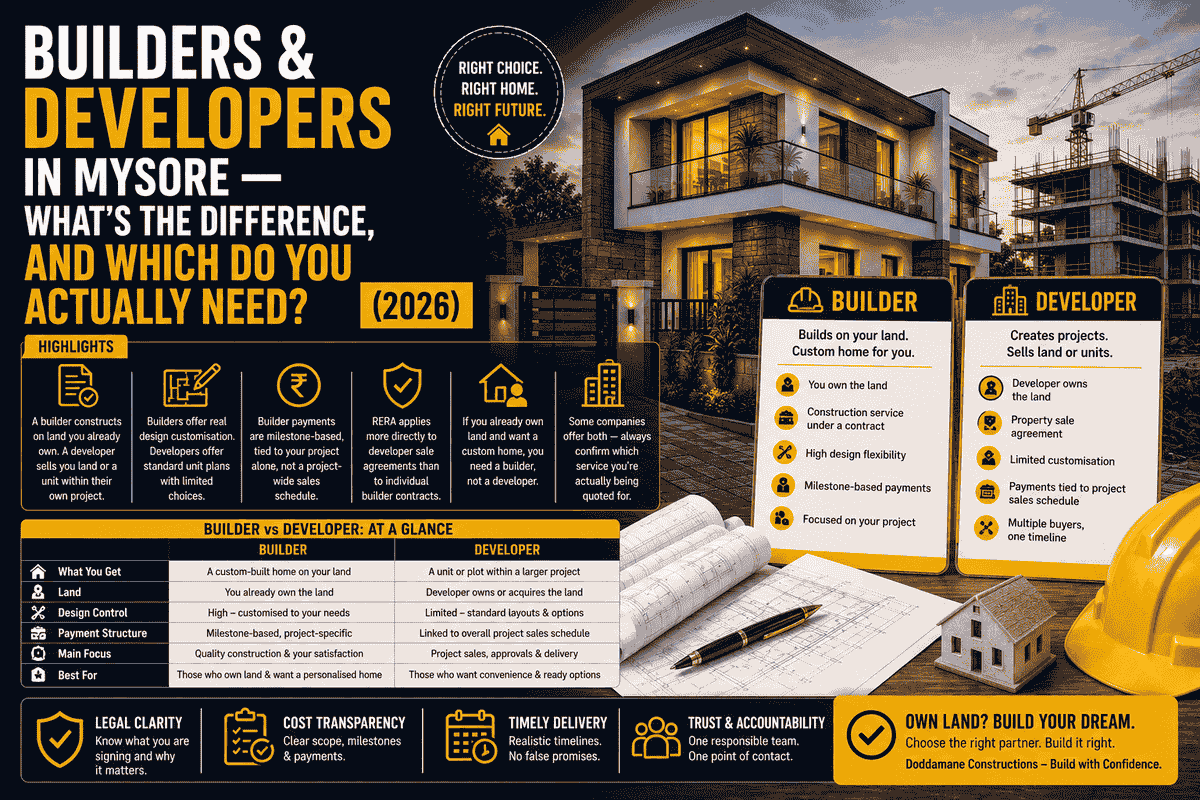
- A builder constructs on land you already own. A developer sells you land or a unit within their own project.
- Builders offer real design customisation. Developers offer standard unit plans with limited choices.
- Builder payments are milestone-based, tied to your project alone, not a project-wide sales schedule.
- RERA applies more directly to developer sale agreements than to individual builder construction contracts.
- If you already own land and want a custom home, you need a builder, not a developer.
- Some companies offer both, always confirm which service you’re actually being quoted for.
Most homeowners in Mysore use “builder” and “developer” interchangeably, right up until they sign a contract with the wrong one and realise it does not cover what they assumed it would. The two are genuinely different businesses, with different scopes, different risks, and different reasons you would hire one over the other.
This guide covers what each one actually does, how to tell them apart when you are evaluating a company, and how to figure out which one your specific project actually needs. It is a distinction worth getting right before you sign anything, since a construction agreement and a property sale agreement protect you in very different ways.
What a Builder Actually Does
A builder, sometimes called a construction company or a turnkey contractor, constructs a building on land you already own. You bring the plot, and the builder brings the design execution, materials, labour, and project management to turn it into a finished home.
A builder’s relationship with you is a construction contract, not a property sale. You are paying for a service, the physical act of building, not for land or a finished unit that already exists. This means you typically have far more control over layout, materials, and design decisions, since the home is being built specifically for you, not built speculatively and sold afterward.
Doddamane operates as a builder. We do not sell plots or apartments. We construct independent houses, duplexes, and G+1/G+2 homes on land our clients already own. The payment structure reflects this too, builders typically work on a milestone-based schedule tied to construction progress, foundation, structure, roofing, finishing, rather than a booking amount followed by instalments tied to a sales timeline.
What a Developer Actually Does
A developer, or a real estate developer, typically buys or partners on land, obtains layout and construction approvals, builds a project such as an apartment complex, villa layout, or residential plots, and then sells individual units or plots to buyers.
The relationship with a developer is fundamentally a property purchase. You are buying something that is being built, or has already been built, largely to the developer’s own specifications, not something designed around your individual requirements. Customisation is usually limited to a handful of pre-approved choices, flooring options, fittings, sometimes minor layout variants, rather than a home designed from scratch for you.
Developers also carry a different kind of business risk than builders. They have capital tied up in land and approvals before a single buyer commits, and their timeline is driven by sales velocity as much as construction speed, a project with slow sales can see construction pace affected, even if individual buyers have paid on schedule.
Payment structures with developers are usually tied to construction milestones set by the developer, not negotiated per buyer, and often include a booking amount paid well before construction on your specific unit has meaningfully progressed.
The Core Differences
The distinction comes down to what you are actually acquiring and how much control you have over the outcome.
With a builder, you already own the land, and you are paying for construction services on a fixed scope you help define. With a developer, you are purchasing a unit or plot within a larger project the developer conceived, financed, and is executing on their own timeline and to their own specifications.
Control over design follows the same logic. A builder works from your requirements, or close variations of them, since the home is being built specifically for your family. A developer works from a standard set of unit plans applied across the whole project, with limited scope for individual customisation.
Risk exposure differs too. With a builder, your primary risks are construction quality, timeline adherence, and cost overruns on a project you control. With a developer, you are also exposed to project-level risks that are largely outside your visibility, delays in the developer’s own approvals, the financial health of the developer’s broader project, and construction quality across a scale you are not personally supervising.
Quick Reference Table
| Builder | Developer | |
| What you’re buying | Construction services on land you own | A unit or plot within their project |
| Land ownership | You already own it | Developer owns/controls it until sale |
| Design control | High, built to your requirements | Low, standard unit plans |
| Contract type | Construction service agreement | Property sale agreement |
| Payment structure | Milestones tied to your build | Schedule set by the project |
| Timeline driver | Your project alone | Project-wide sales & approvals |
| RERA applicability | Limited, mostly project-based | Applies directly in most cases |
The Contract Itself Looks Different Too
A construction agreement with a builder centres on scope of work, specifications, materials, timeline, and milestone payments tied to physical progress you can verify by visiting the site. Change orders (adjustments to the original scope) are typically negotiated directly with the builder as they come up.
A sale agreement with a developer centres on the unit or plot being purchased, its specifications as stated in the project’s approved plan, delivery timeline, and payment schedule tied to construction milestones the developer sets across the whole project. Karnataka’s RERA framework governs developer sale agreements more directly than it does individual builder-client construction contracts, since RERA was built primarily around real estate project sales rather than one-off construction services.
This is worth knowing before you sign anything, because the protections and obligations that apply to a developer’s sale agreement do not automatically carry over to a builder’s construction contract, and vice versa.
Which One Do You Actually Need?
The honest answer depends entirely on where you are starting from and what you are actually looking for.
If you already own a plot, or you are planning to buy land and build a house specifically designed around how your family lives, you need a builder. This is the only path that gives you real control over layout, materials, and the pace of construction, and it is the more direct route to a home built to your exact requirements rather than a template.
If you do not own land, are not looking to manage a construction project yourself, and want a ready or near-ready home, typically an apartment or a unit in a villa layout, a developer’s project may be the better fit. You trade customisation for convenience, someone else handles land acquisition, approvals, and construction management, and you buy the outcome. This path also tends to suit buyers prioritising a fixed move-in timeline over design control, since a developer’s unit is either already built or being built to a published schedule.
There is a middle scenario worth naming honestly: some homeowners buy a plot specifically because they want more control than a developer’s project offers, but then assume the flexibility of ownership. That flexibility only exists if you hire the right kind of company. If your goal is a home designed around your specific needs, hiring a developer to build on your own land, when that is even an option, usually will not get you the customisation you are expecting. That is a builder’s job.
Common Mistakes Homeowners Make
The most frequent misunderstanding we see is a homeowner assuming that because a company is large and well known locally, it must offer the same customisation a smaller, dedicated builder would. Scale and customisation do not automatically go together. A developer running several projects simultaneously is optimising for repeatable unit designs, not individual family requirements.
The second common mistake runs the other way: assuming a builder can help you find and acquire land, the way a developer’s project already has land baked in. Most builders, Doddamane included, work on land you already own or are in the process of finalising. If you are still land-hunting, that search typically happens separately, through a broker or directly, before a builder’s construction contract begins.
A third mistake is not checking which category a company actually falls into before requesting a quote. Some businesses in Mysore operate as both, offering developer-style plotted layouts alongside builder-style construction contracts. It is worth asking directly which service you are being quoted for, since the contract terms, payment structure, and your level of control differ significantly between the two.
A fourth, less obvious mistake is assuming timeline expectations transfer directly between the two models. A builder’s timeline is usually driven by your project alone, so delays elsewhere do not affect you. A developer’s timeline can be affected by factors entirely outside your unit, other buyers, project-wide approvals, or the developer’s broader financial position, none of which you can see clearly from outside.
How Doddamane Fits Into This
We are a builder, not a developer. We do not acquire land, subdivide it, or sell finished units. Every project we take on starts with a client who already owns their plot and wants a home built specifically around their family’s requirements, milestone-based payments, ISI-certified materials, and a design process that starts with how you actually want to live, not a pre-approved unit plan.
Related reading: How to Choose a Builder in Mysore and Construction Agreement in Mysore — What to Check Before You Sign, both already live on the site.
If you already own land in Mysore and are trying to decide between hiring a builder or going with a developer’s plotted layout, the honest question to ask yourself is how much you actually value customisation over convenience. If the answer is customisation, a builder is the right call.
See the full Doddamane residential construction services for how we approach a custom, founder-led build.
Frequently Asked Questions
What is the main difference between a builder and a developer?
A builder constructs a home on land you already own, under a construction service contract. A developer acquires land, builds a project such as an apartment complex or plotted layout, and sells individual units or plots to buyers.
Can a developer build a custom home on my land?
Generally no. Developers are typically structured around project-level unit plans applied across a development, not individual custom homes. For a home built specifically to your requirements on your own land, a builder is the appropriate choice.
Do I need to already own land to hire a builder?
Yes, in most cases. Builders, including Doddamane, construct on land the client already owns or has finalised. If you do not yet own land, that acquisition typically happens separately before a construction contract begins.
Is it cheaper to buy from a developer than to hire a builder?
Cost comparisons depend heavily on location, unit size, and specification level, and are not consistently cheaper one way or the other. What differs more reliably is what you are paying for, a ready or near-ready unit from a developer, versus a home built specifically around your requirements with a builder.
How do I know if a company is a builder or a developer?
Ask directly whether they are constructing on land you own under a service contract, which makes them a builder, or selling you a unit or plot within their own project, which makes them a developer. Some companies offer both, so it is worth confirming which service applies to your specific inquiry.
Does RERA apply to builders the same way it applies to developers?
RERA in Karnataka was built primarily around real estate project sales, which is why it applies more directly to developer projects than to individual builder-client construction contracts.