
Building Plan Approval in Mysore — MDA, Panchayat, and What Actually Happens in 2026
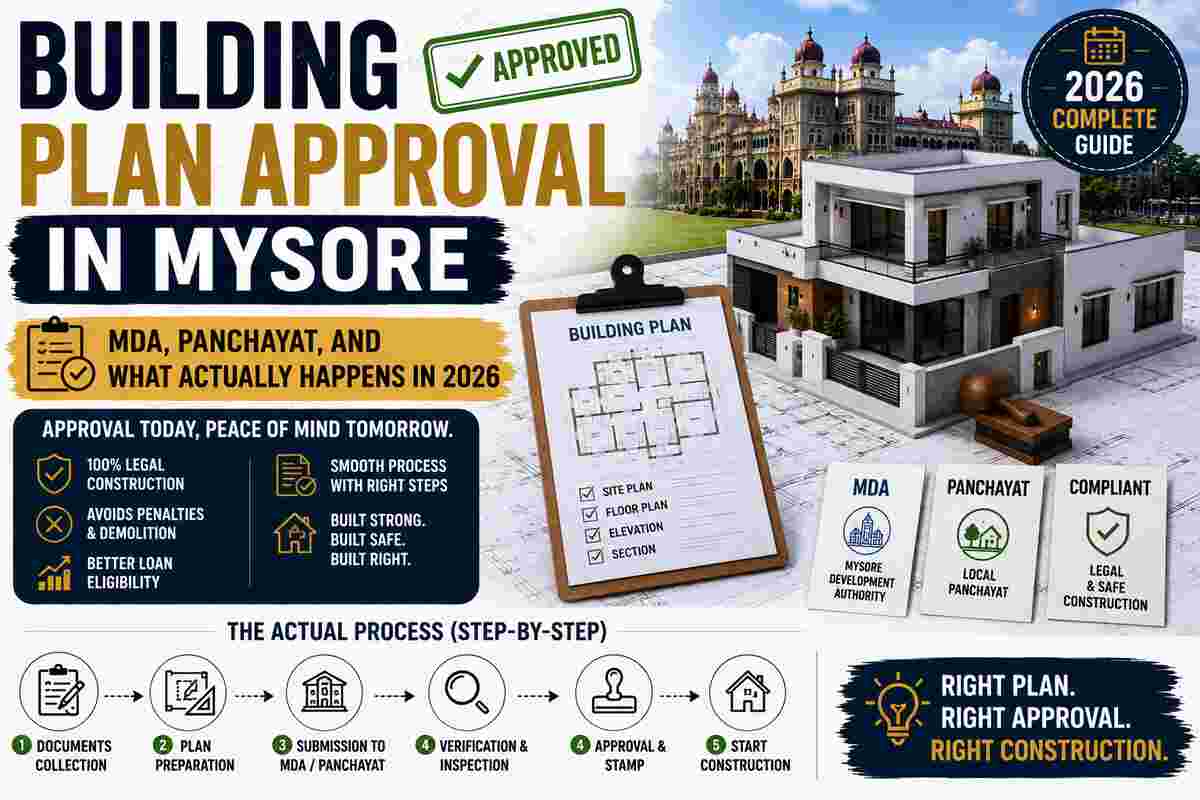
If you have started researching construction approvals in Mysore recently, you have probably noticed something confusing.
Some people still call it MUDA approval. Some say MDA. Some say their plot needs panchayat permission, not MUDA or MDA at all. And a few have been told they need panchayat approval first and then something from the main authority — and they have no idea what that means or why.
This is not confusion without reason. Mysore’s building approval landscape changed significantly in 2025. The authority that governed urban construction in Mysore for decades was dissolved. A new body replaced it. And the boundary between city jurisdiction and panchayat jurisdiction has become increasingly important as Mysore expands outward.
This article is the current, ground-reality guide to building approvals in Mysore in 2026. What has changed. Who approves what. How to find out which authority covers your specific plot. And what the actual process looks like under each.
What Happened — MUDA Is Gone, MDA Has Replaced It
The most important thing to establish upfront is this.
MUDA — the Mysuru Urban Development Authority — was officially dissolved on May 23, 2025.
The Karnataka State Government issued a formal notification on May 14, 2025, implementing the Mysuru Development Authority Act 2024. Under Section 85(1) of the Act, MUDA stood dissolved and the Mysuru Development Authority — MDA — came into existence in its place.
The signboards at the authority’s offices were changed. All official communications, files, and documentation moved to the MDA name. A new structure, new letterheads, and a new governing framework took effect.
This is not a minor rebranding. The MDA is a structurally different organisation from MUDA. Here is what changed:
Governance structure. MUDA had 14 elected legislators — MLAs and MLCs — as part of its governing body. The MDA has only one. The rest of the governing board is made up of senior government officers, engineers, urban planners, and financial experts. The intent is a less political, more technically driven authority.
Autonomy. MDA is modelled on the Bangalore Development Authority — BDA. Like BDA, it is intended to operate with greater financial and administrative autonomy — generating its own revenue rather than depending entirely on state government funding.
Expanded powers. MDA can now take charge of layout development, road construction, land acquisition, drainage, water supply, and urban planning in a more integrated way than MUDA could.
Stricter infrastructure obligations. Builders and developers must now provide proper infrastructure — roads, water supply, drainage, and lighting — before plots can be sold within new layouts. This is a significant tightening of the rules that applied under MUDA.
What has not changed for a homeowner building a residential home: The fundamental requirement to get your building plan approved before you break ground remains exactly the same. The approving authority’s name changed. The requirement did not.
However — there is an important practical reality. The transition from MUDA to MDA was not instantaneous in terms of systems, processes, and staff familiarity. Applications filed in 2025 during the transition period experienced some additional delays as the new authority established its processes. By 2026, the MDA approval process has largely stabilised — but homeowners should be aware that some procedural details are still being refined, and working with an architect who regularly files with MDA is more important than ever.
The Three Authorities — Who Approves What in Mysore
This is where most homeowners get confused. In Mysore in 2026, there are three distinct approving authorities for residential building plans — and which one applies to your plot depends entirely on where your plot is located.
Authority 1 — Mysuru Development Authority (MDA)
MDA has jurisdiction over plots within the Mysuru Local Planning Area — broadly, Mysore city and its planned urban growth boundaries.
Most established residential localities fall within MDA jurisdiction. If your plot is in a layout that was previously MUDA-approved — JP Nagar, Kuvempunagar, Srirampura, Vijayanagar, Hebbal, Hootagalli, Dattagalli, Jayanagar, and similar established Mysore localities — your building plan approval will be processed through MDA.
MDA applies a defined set of building regulations — setbacks, FSI, height restrictions, parking requirements — that are specific to the zone in which your plot sits.
Authority 2 — Mysuru City Corporation (MCC)
The Mysuru City Corporation has building approval jurisdiction within the core city corporation limits. MCC approval is typically for properties within the older, more densely built parts of Mysore — areas within the original corporation boundary.
For most residential homeowners building on plots in the layouts and extensions outside the core city, MDA is the more relevant authority. But for plots in areas like central Mysore, Nazarbad, Lashkar, and similar older localities, it is worth verifying whether the approving authority is MCC or MDA.
Authority 3 — Gram Panchayat
Gram Panchayats have building approval jurisdiction over plots in areas outside the MDA and MCC limits — typically the villages, satellite areas, and newer developments on Mysore’s periphery.
As Mysore has expanded outward over the past decade, many new layouts have emerged in areas that are technically within gram panchayat jurisdiction — even though they are practically on the edge of the city. Plots in areas like Bogadi, Belavadi, some parts of Nanjangud Road, Hootagalli industrial area borders, and newer peripheral localities may fall under gram panchayat jurisdiction rather than MDA.
This distinction matters enormously because the approval process, the applicable regulations, and the documentation requirements are different under each authority.
How to Find Out Which Authority Has Jurisdiction Over Your Plot
This is the single most important question to answer before you do anything else.
Do not assume. Do not guess based on how close your plot is to the city. Verify.
Step 1 — Check your khata document. Your plot’s khata — the property account document — is issued by a specific authority. If your khata is issued by MDA (or MUDA, which is now MDA), your plot is in MDA jurisdiction. If it is issued by the gram panchayat, you are in panchayat jurisdiction. If it is issued by MCC, you are in MCC jurisdiction.
Step 2 — Check the layout approval. If your plot is in a layout, the layout will have been approved by a specific authority — MDA, a previous authority, or the panchayat. The layout approval document names the approving authority.
Step 3 — Ask your architect. Any architect who regularly practises in Mysore will know immediately which authority covers which areas. This is genuinely the fastest way to get a reliable answer.
Step 4 — Visit the MDA office. The MDA office in Mysore can confirm jurisdiction for any specific plot number and survey number. Bring your title deed and survey sketch.
The MDA Approval Process — How It Works in 2026
For plots within MDA jurisdiction, the building plan approval process works as follows.
Who can file the application: A licensed architect — registered with the Council of Architecture and empanelled with MDA. Your turnkey builder alone cannot file without an architect.
Documents required:
- Title deed or registered sale document
- Khata certificate and khata extract in the applicant’s name
- Encumbrance certificate — minimum 13 years — from the sub-registrar’s office
- Current property tax paid receipt
- Betterment charges receipt if applicable
- Certified survey sketch from the Survey Department
- Layout plan showing plot location
- Complete architectural drawings — site plan, floor plans, elevations, sections
- Structural drawings signed by a licensed structural engineer
- Stability certificate from the structural engineer
- Application form with applicant details and declaration
- Demand draft or challan for application fees
The process: Application is submitted through MDA’s online portal. Documents are uploaded in specified formats. The application fee is calculated on built-up area and paid digitally.
MDA’s technical team scrutinises the submission for regulatory compliance — setbacks, FSI, height, parking, and document completeness. A site inspection may be conducted.
If compliant, the sanctioned plan is issued. If deficient, a deficiency notice is raised and the application must be corrected and resubmitted.
Timeline: For a clean, complete application on a straightforward residential plot — 45 to 75 days from submission to sanction is the realistic current range. Applications requiring resubmission for deficiencies take 75 to 100 days. Applications with underlying document discrepancies take longer.
The Panchayat Approval Process — How It Works and How It Differs
For plots in gram panchayat jurisdiction, the building approval process is handled differently — and this is where homeowners in Mysore’s peripheral areas face the most confusion.
Who issues panchayat approval: The gram panchayat for the village within whose boundaries your plot sits. Each village has its own gram panchayat.
Is panchayat approval a lesser or less legitimate approval? No. A building approved by the gram panchayat under the applicable panchayat building regulations is a legally approved building. The approval is specific to that panchayat’s jurisdiction and the regulations applicable within it.
The process:
The application is submitted to the gram panchayat office rather than MDA. The documents required are broadly similar — title deed, khata, encumbrance certificate, architectural drawings — but the format requirements and fee structure are different and specific to each panchayat.
The gram panchayat’s PDO — Panchayat Development Officer — or the designated building inspector reviews the application for compliance with the applicable building bylaws.
The regulations governing construction in panchayat areas are set by the Karnataka Panchayati Raj Act and the applicable state building bylaws for rural and semi-urban areas. These differ from MDA’s urban building regulations — the permitted FSI, setbacks, and height restrictions may be different.
Panchayat approval is generally faster than MDA approval — typically 30 to 45 days for a straightforward application — because the process involves fewer layers of technical scrutiny. However, this varies significantly by panchayat.
The important limitation of panchayat approval: Buildings approved only by the gram panchayat are sometimes treated differently in property transactions when the area eventually gets merged into urban limits. When an area is included within MDA or MCC jurisdiction — which has happened repeatedly as Mysore expands — existing buildings may need regularisation. Understanding this before you build in a peripheral area is important.
The Panchayat Plus MDA Situation — When Both Come Into Play
This is the specific scenario that creates the most confusion — and it is more common than most homeowners realise.
Some plots in Mysore’s expanding areas sit in layouts that have panchayat khata but have partially come under MDA’s planning jurisdiction — or are in the process of being included. In these cases, homeowners are sometimes told they need panchayat approval for the building itself, but they also need to verify with MDA or obtain an NOC from a planning authority.
The most common situations where this arises:
Layouts formed in panchayat areas that are within MDA’s Local Planning Area (LPA) boundary. MDA’s Local Planning Area is larger than the areas where MDA directly issues building permissions. Within the LPA, even if the day-to-day building approval is handled by the panchayat, the layout should comply with the MDA’s structural plan. This creates a layer of coordination.
Layouts being regularised. Some layouts in Mysore’s periphery were formed and sold before the relevant authority had formally approved the layout. Plots in these layouts are in a regularisation process. Building approvals in these areas may require the regularisation to be completed before a standard approval is issued — or may be issued with specific conditions.
Transition areas where jurisdiction has recently shifted. As MDA’s jurisdiction has expanded, some areas that were previously purely panchayat jurisdiction have moved into MDA’s scope. Plots in these areas may have panchayat khata that has not yet been transferred to MDA khata — creating a situation where the homeowner needs to get the khata updated before a standard MDA approval can be processed.
The practical guidance for homeowners in any of these situations: Do not assume the approval is straightforward. Engage an architect who works regularly in the relevant area — they will know the current status of your specific locality far better than any general guide can tell you. The specific village, the specific layout, and the current stage of any jurisdiction transition all affect what is required.
What Has Not Changed — The Fundamental Requirement
Despite all the changes described above — MUDA becoming MDA, panchayat jurisdiction for peripheral plots, transition areas — one thing has not changed at all.
You cannot legally begin construction without an approved building plan.
This is true whether your approving authority is MDA, MCC, or your gram panchayat. It is true in the centre of Mysore and on the periphery. It is true for a 20×30 plot and a 40×60 plot.
A home built without approval:
- Cannot get a legal BESCOM electricity connection in most cases
- Cannot get a legal water connection
- Is extremely difficult to sell — particularly to a buyer using a home loan, because banks require the sanctioned plan
- Cannot get a completion certificate
- Is at legal risk of demolition notice if the authority conducts a survey
The approval process has genuine costs — fees, architect charges, and time. But they are small compared to the consequences of skipping it.
The Most Common Reasons Approvals Get Delayed in Mysore
Whether through MDA or a panchayat, these are the most frequent causes of delay based on current ground reality.
Document discrepancies. The single most common cause. The name in the title deed does not match the name in the khata. The plot dimensions in the survey sketch differ from the sale deed. The encumbrance certificate shows a mortgage that was discharged but not formally recorded. Every discrepancy must be resolved before the approval process can proceed.
Betterment charges not paid. For plots in MUDA-released layouts, betterment charges are a one-time payment due to the authority. If these have not been paid — which is common on plots purchased from a previous owner — they must be cleared before approval.
Incorrect or incomplete drawings. Drawings submitted without the full set — missing sections, missing structural drawings, dimensions not matching across plans and sections — result in deficiency notices and resubmission.
FSI or setback violations in the proposed design. If the architect’s design exceeds the permissible FSI or violates setbacks, the plan must be redesigned and resubmitted. Working with an architect who verifies compliance before finalising drawings avoids this entirely.
Transition and regularisation delays. For plots in areas affected by jurisdiction transitions or layout regularisation, delays can be structural — outside anyone’s direct control — and can run to several months.
The most effective way to minimise delays: Engage an architect with current, active experience filing with MDA specifically. Start the document verification and collection process as early as possible — ideally while you are still finalising your builder selection. And do not break ground until the sanctioned plan is physically in your hands.
A Practical Quick Reference
| Your Plot Location | Likely Approving Authority | Typical Timeline |
|---|---|---|
| Established Mysore layout — JP Nagar, Kuvempunagar, Srirampura, Vijayanagar etc | MDA | 45–75 days |
| Core city — Nazarbad, Lashkar, central Mysore | MCC | 45–60 days |
| Peripheral village or newer development area | Gram Panchayat | 30–45 days |
| Transition / partially-included area | Panchayat + MDA coordination | 60–120 days |
| Layout in regularisation process | Varies significantly | Often 90+ days |
Frequently Asked Questions
What is MDA in Mysore — is it the same as MUDA? MDA — Mysuru Development Authority — replaced MUDA — Mysuru Urban Development Authority — on May 23, 2025, when the Karnataka Government dissolved MUDA under the Mysuru Development Authority Act 2024. MDA is modelled on the Bangalore Development Authority and has a more technical, less political governance structure. For homeowners seeking building plan approval in Mysore, MDA is the current authority — not MUDA.
Do I need MUDA approval or MDA approval in 2026? MUDA no longer exists. If your plot is within MDA’s jurisdiction, you need MDA building plan approval. All applications that would previously have gone to MUDA now go to MDA. The requirement for building plan approval before construction has not changed — only the name of the authority.
How do I know if my plot needs MDA approval or Panchayat approval? Check your plot’s khata document. If the khata is issued by MDA or by the previous MUDA, your plot is in MDA jurisdiction. If it is issued by the gram panchayat, your approval goes through the panchayat. Your architect can verify this quickly from your title deed and survey sketch.
What is Gram Panchayat building approval in Mysore? For plots in village areas outside MDA and MCC jurisdiction — many of Mysore’s peripheral localities — building plan approval is issued by the gram panchayat. The process is handled at the local panchayat office rather than the MDA office. The regulations and fee structure are different from MDA. Panchayat approval is a legitimate legal approval for the area in which it is issued.
How long does MDA building plan approval take in Mysore in 2026? For a clean, complete application on a straightforward residential plot, MDA approval in Mysore currently takes 45 to 75 days from submission to sanction. Applications requiring resubmission for deficiencies take 75 to 100 days. Applications with document discrepancies can take longer. Starting the process early — before you are ready to begin construction — is the most effective way to avoid timeline delays.
Can I start construction before MDA or Panchayat approval is received? No. Construction cannot legally begin before the sanctioned building plan is in your hands. A home built without approval cannot legally receive BESCOM and water connections, cannot get a completion certificate, and is difficult to sell using a home loan. The sanctioned plan must be obtained before any site work begins.
What documents do I need for MDA building plan approval in Mysore? The core documents required are: registered title deed, MDA khata certificate and extract, encumbrance certificate for 13 years, current property tax receipt, betterment charges receipt if applicable, certified survey sketch, complete architectural drawings, structural drawings with stability certificate, and the completed application form with fees. Your architect will prepare and verify the full document set before submission.
Also useful: → How Long Does It Take to Build a House in Mysore? → What to Check in a Construction Agreement Before Signing → Construction Cost Per Sq Ft in Mysore in 2026 → How to Choose a Builder in Mysore — 7 Questions to Ask
Planning to build in Mysore and unsure which approval authority covers your plot — or want a builder who handles the full approval process as part of the turnkey scope? Talk to our team.
[Talk to Doddamane Constructions →]






One Comment