Encumbrance Certificate in Mysore — What It Is and Why You Need One Before You Build (2026)
Highlights
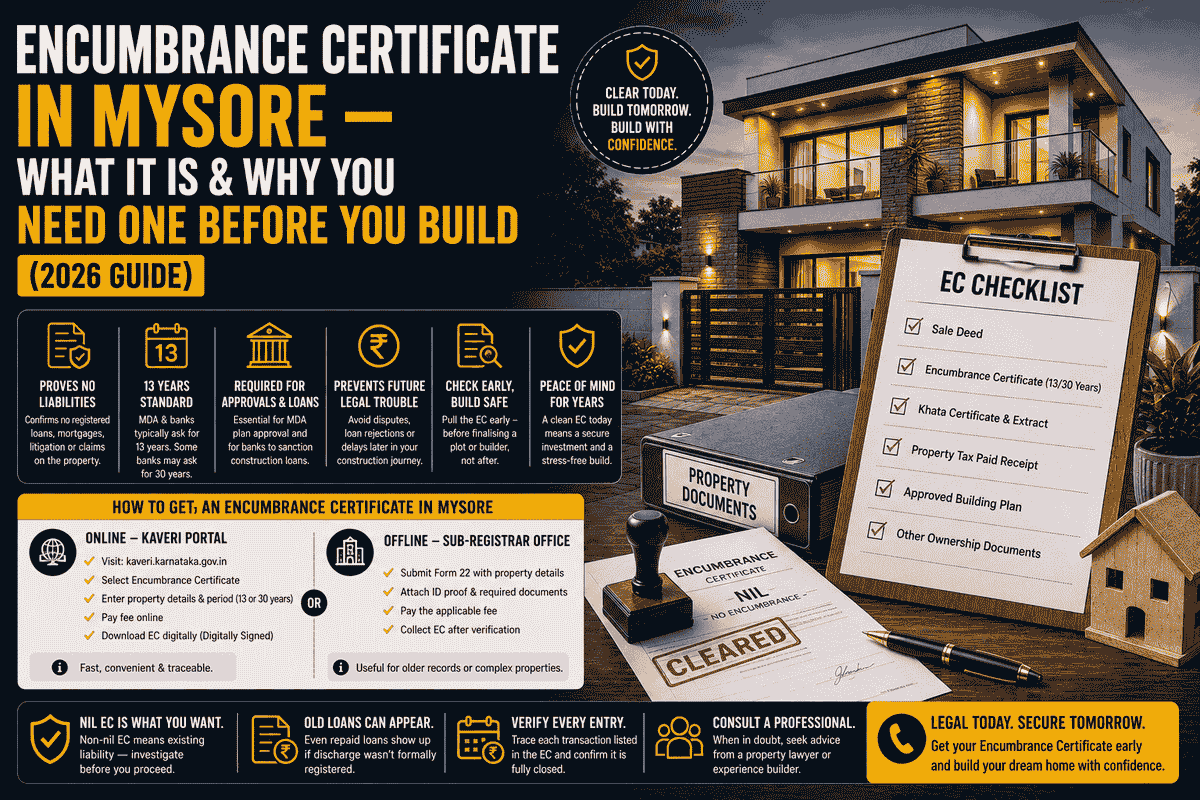
- An EC proves no registered liabilities exist, it does not confirm ownership or boundaries, that’s the Sale Deed and Khata’s job.
- MDA and banks typically want 13 years covered; some lenders may ask for 30.
- Apply via Karnataka’s Kaveri Online Services portal, or in person with Form 22 at the sub-registrar’s office.
- A “nil” EC is what you want. A non-nil EC needs each listed transaction traced and confirmed closed.
- Old loans that were actually repaid can still show up if the discharge was never formally registered.
- Pull the EC early, before finalising a builder, not after construction has started.
An Encumbrance Certificate is one of those documents everyone mentions and almost nobody explains properly. You are told you need one before you build, before a bank will fund your construction loan, and before MDA will process your building plan approval, but the actual explanation usually stops at “you just need it.”
Here is what the encumbrance certificate mysore homeowners are asked for actually proves, why it typically needs to cover a specific stretch of years, and how to get one without wasting a trip to the sub-registrar’s office.
This matters most at the exact moment homeowners tend to skip it, right after finalising a plot and right before finalising a builder, when the temptation is to move fast rather than verify.
What an Encumbrance Certificate Actually Proves
An encumbrance certificate mysore homeowners request from the sub-registrar’s office, usually shortened to EC, is an official record confirming whether a property has any registered legal or financial liability against it during a specific period. This includes mortgages, loans taken against the property, ongoing litigation, or any other registered claim that could affect clear ownership.
In plain terms, the EC tells you and anyone you deal with, a bank, MDA, a future buyer, that the property is not secretly tied up in someone else’s loan or legal dispute. It does not certify the physical condition of the land, and it does not confirm the accuracy of boundaries or extent, it is strictly a record of registered transactions and encumbrances tied to that specific property.
This is why an EC matters before construction even starts. If a bank later discovers an undisclosed mortgage on the land you are building on, your own construction loan can be affected, and in a worst case, ownership of the property itself can become legally contested.
It is worth being precise about what the EC does not cover too. It will not tell you whether the seller has clear title in the first place, that is what the Sale Deed and the broader chain of title documents establish. The EC only confirms whether registered liabilities exist against the property during the period you request, which is why it is typically checked alongside the Sale Deed and Khata, not as a replacement for either.
Why MDA and Banks Typically Ask for 13 Years
If you have come across the term encumbrance certificate 13 years mysore while researching, this is exactly what it refers to, the 13-year window is not an arbitrary number. It is tied to the limitation period under Indian property law for certain kinds of claims against a property, after which many types of legal challenges to ownership become significantly harder to bring.
A 13-year EC gives a reasonably strong picture of whether the property has stayed free of encumbrance across a legally meaningful stretch of time, rather than just the last year or two.
In practice, MDA, most banks, and most experienced buyers will ask for a 13-year EC as the standard for a clean title check on residential land in and around Mysore, though some transactions may require a longer period depending on the property’s history.
If a plot has changed hands multiple times, or if a bank’s internal lending policy is more conservative, you may be asked for a 30-year EC instead. It is worth confirming the required period with your lender or with MDA directly before applying, rather than defaulting to 13 years and having to reapply for a longer window later.
How to Get an Encumbrance Certificate in Mysore
If you are searching for how to get encumbrance certificate mysore instructions, there are two practical routes, and which one makes sense depends on how far back your search needs to go and how quickly you need the certificate.
The most common route today is Karnataka’s Kaveri Online Services portal, the state’s official platform for property registration and related certificate applications. You can apply for an EC online by providing the property’s survey number, village or ward details, and the period you need the certificate to cover.
The alternative is applying in person at the sub-registrar’s office covering the property’s jurisdiction. This is still common for older properties or where the digital records do not fully capture the ownership history, and it usually involves filling out Form 22 (the standard EC application form), paying the applicable fee, and providing the same property identification details, survey number, extent, and the years to be covered.
Whichever route you use, processing generally takes a few working days once the application is correctly filed, though this can extend if the sub-registrar’s office needs to manually verify older records not yet digitised. Properties with a longer or more complicated transaction history, multiple past owners, partial sales, or inherited shares, tend to take longer to certify, simply because there is more historical record to check.
What You Need Before You Apply
Applying for an EC is straightforward if you have the right details ready. You will typically need the property’s survey number and sub-division details, the village, hobli, or ward it falls under, the exact period you want the certificate to cover, usually 13 years for a standard construction or loan purpose, and basic identity proof of the applicant.
If you already have the Sale Deed for the property, keep it on hand, since the survey number and boundary details on the EC application should match it exactly. A mismatch here is one of the more common reasons an application gets delayed or kicked back for correction.
If you are applying through the online portal, having a scanned copy of the Sale Deed ready to upload alongside the application will also speed things up considerably, since it lets the registrar cross-check the details without a separate document request cycle.
Quick Reference Table
| Question | What It Means |
| What does an EC prove? | No registered legal/financial liability on the property during the period checked |
| Standard period requested | 13 years (some lenders may ask for 30) |
| Where to apply | Kaveri Online Services portal, or in person at the sub-registrar’s office |
| Form needed (offline) | Form 22 |
| Typical processing time | A few working days for correctly filed applications |
| “Nil” result means | No liabilities found, this is what you want to see |
| Non-nil result means | Trace each listed transaction; confirm closed with a release/discharge document |
What a “Nil” vs a Non-Nil Encumbrance Certificate Means
An EC will come back as either “nil encumbrance,” meaning no registered liabilities were found for the property during the requested period, or it will list specific transactions, mortgages, loans, or other registered claims, that were recorded against the property.
A nil EC is what most buyers and lenders want to see. A non-nil EC is not automatically a dealbreaker, older mortgages that were properly closed and released will still show up on the record, but it does mean you need to trace each listed transaction and confirm it was legitimately closed, with a release deed or discharge document, before proceeding with confidence.
This is where a lot of homeowners get stuck without realising it. A non-nil EC on a property that changed hands two or three owners ago can list a home loan from a previous owner that was fully repaid years earlier, but if the discharge was never formally registered, the EC will keep showing it as an open encumbrance indefinitely. Resolving this usually means tracking down the original lender for a release confirmation, which is far easier to do before you have committed to the property than after.
Encumbrance Certificate vs Khata vs Sale Deed
These three documents get confused often enough that it is worth being direct about what each one actually does. The Sale Deed proves ownership, it is the legal transfer document showing the property changed hands to you.
The Khata is the municipal or panchayat tax record, establishing who is liable for property tax and, in Karnataka, whether the property is eligible for a building plan sanction. The Encumbrance Certificate proves the property is free of registered liabilities during a given period.
None of the three substitutes for the others. A property can have a perfectly valid Sale Deed and an up-to-date Khata while still carrying an undisclosed mortgage that only the EC would reveal. Homeowners who only check one or two of these before buying or building are taking on risk they do not need to.
How Doddamane Handles This for Clients
Document verification, including confirming a clean encumbrance certificate mysore authorities will accept, happens before we finalise a construction agreement with a client, not after ground has already been broken.
If an EC comes back non-nil, we flag exactly what needs to be traced and resolved before construction begins, rather than letting it become a mid-project surprise.
If you already own your plot and are preparing to start construction, getting a current EC pulled early, well before you finalise a builder or a design, gives you time to resolve any issues without it holding up your actual construction timeline.
Related reading: How to Choose a Builder in Mysore and Mysore Building Approvals — MDA/Panchayat Guide,
See the full Doddamane residential construction services for how document verification fits into our turnkey process.
Frequently Asked Questions
What is an Encumbrance Certificate used for?
An encumbrance certificate mysore banks and MDA both require confirms whether a property has any registered legal or financial liability, such as a mortgage or ongoing dispute, during a specific period. It is required for construction loans, MDA building plan approvals, and most property transactions.
Why do I need a 13-year Encumbrance Certificate specifically?
The 13-year period is tied to legal limitation periods relevant to certain property claims, giving a meaningful look-back window for confirming clear title.
How long does it take to get an Encumbrance Certificate in Mysore?
Processing typically takes a few working days for a correctly filed application, though older or non-digitised records can take longer to verify manually.
What does it mean if my Encumbrance Certificate is not nil?
It means one or more registered transactions were found against the property during the requested period. This is not automatically a problem, but each listed transaction needs to be traced and confirmed as properly closed before proceeding.
Can I apply for an Encumbrance Certificate online in Karnataka?
Yes, through the state’s Kaveri Online Services portal, by providing the property’s survey number, location details, and the period you need covered.
Is an Encumbrance Certificate the same as a Khata certificate?
No. The Khata establishes property tax liability and building plan eligibility, while the EC confirms the property is free of registered legal or financial claims during a specific period. Both are typically required, but they serve different purposes.