Civil Contractors in Mysore — What to Look for in a Commercial Construction Partner (2026)
Highlights
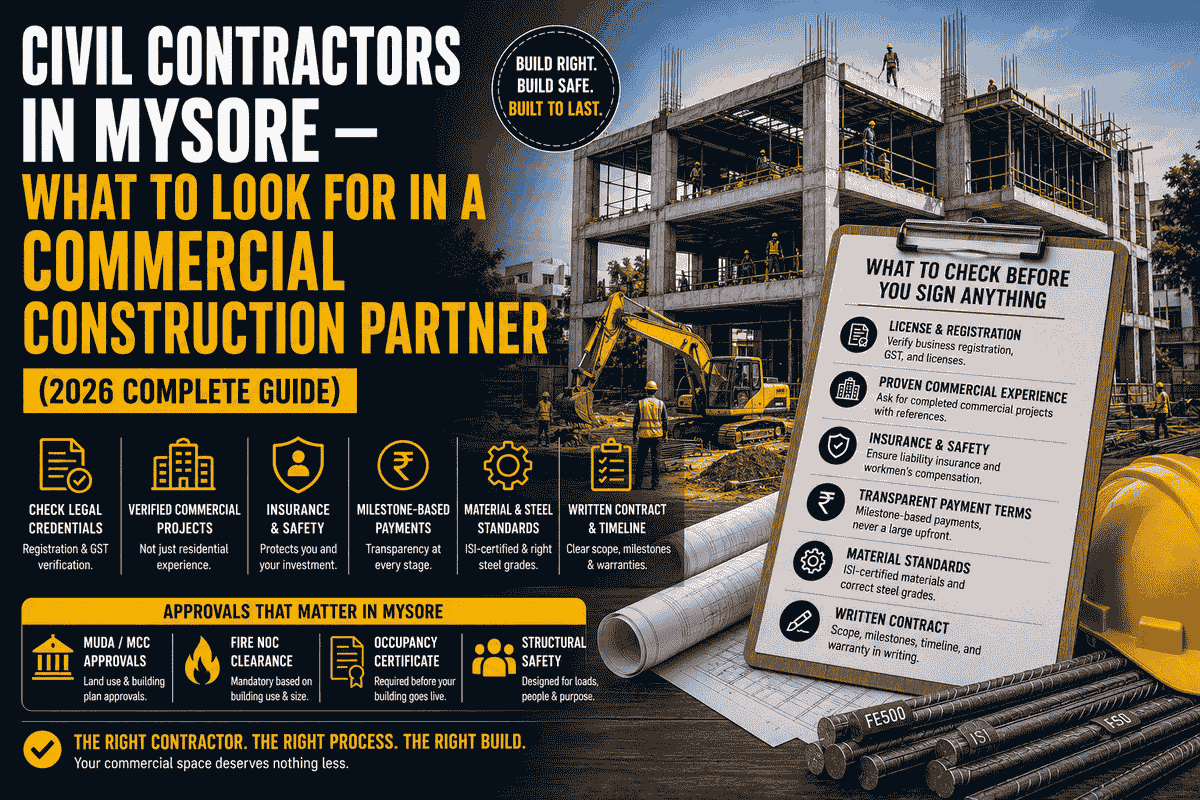
- Check business registration and GST before anything else — hesitation here is a real warning sign.
- Ask for verified commercial project history, not just residential work.
- Confirm liability insurance and workmen’s compensation coverage for the crew.
- Insist on a milestone-based payment structure, never a large upfront payment.
- Verify ISI-certified material standards and direct experience with MUDA/MCC commercial approvals.
- Get scope, milestones, and timeline in a written contract before work begins.
If you are planning to build an office, a retail outlet, or a mixed-use commercial space in Mysore, the contractor you hire matters more than almost any other decision you will make on the project. A civil contractor handles the structural backbone of the building: foundation, columns, slabs, and the load-bearing work everything else depends on. Get this part wrong and you are not looking at a cosmetic fix later, you are looking at structural remediation, regulatory trouble, or in the worst case, a building that cannot pass occupancy inspection.
Commercial construction in Mysore has grown quickly over the last few years, and with that growth has come a wider spread in the quality of civil contractors available. Some are licensed, insured, and genuinely equipped to handle a commercial-scale structural job. Others have only ever worked on residential sites and are learning commercial code compliance on your project, at your expense.
This guide walks through what a civil contractor actually does, how commercial vetting differs from hiring for a house, and the specific things to check before you sign anything.
Whether you are building a small retail outlet, a standalone office building, or a larger mixed-use commercial property, the fundamentals of vetting a civil contractor do not change much. What changes is the scale of what is at stake: a structural mistake on a commercial building affects everyone who walks through it, not just the family who owns it.
What a Civil Contractor Actually Does on a Commercial Project
The term “civil contractor” gets used loosely in Mysore, so it helps to be precise about scope before you start comparing quotes.
A civil contractor is responsible for the structural and site work: excavation, foundation, RCC framework (columns, beams, slabs), masonry, and waterproofing. This is different from a finishing contractor, who handles flooring, painting, false ceilings, and interiors, and different again from an MEP contractor, who handles mechanical, electrical, and plumbing systems. On a commercial build, these three scopes often run in parallel with different vendors, which is exactly where coordination problems start if one of them is weak.
When you search for civil construction companies in Mysore, you will find two broad categories. The first is dedicated civil contracting firms that only take on structural work and hand the project back to you or your project manager once the shell is complete. The second is full-service construction companies, civil companies in Mysore that manage the entire build including civil, finishing, and MEP under one contract.
For a commercial project, the full-service model usually reduces your coordination risk, because a single company is accountable for how the structural work interfaces with everything built on top of it. But whichever model you choose, the civil contractor’s own competence is what determines whether the building is structurally sound, code-compliant, and ready to pass inspection on schedule.
Why Commercial Projects Need a Different Vetting Process Than a House
Residential and commercial construction are governed by different rules, and a contractor who has only built houses will not automatically know how to navigate the commercial side.
Commercial buildings in Mysore fall under stricter fire safety norms, occupancy load calculations, and structural design requirements than a typical residential build, because they are designed for public footfall rather than a single family. Depending on the size and use of the property, you may need fire NOC clearance, a commercial occupancy certificate, and approvals from MUDA or the Mysuru City Corporation that a residential plot never requires.
The structural load calculations are also different. A commercial space built for retail footfall, heavy signage, HVAC loads, or server rooms needs a structural design that accounts for that use case from the foundation up. A contractor who defaults to residential-grade specifications because that is what they know will either overbuild and inflate your cost, or under build and create a genuine safety and compliance risk.
This is the core reason commercial vetting has to go further than checking whether a contractor has “experience in construction.” You need to know specifically whether they have handled commercial-scale structural work, commercial approvals, and commercial safety compliance, not just houses. The timeline implications matter too: a commercial approval process that a contractor has never navigated before can add weeks or months to your schedule if they are learning it as they go, rather than executing a process they already know.
The Vetting Checklist — What to Actually Check Before You Sign
1. Licensing and registration
Ask for the contractor’s business registration, GST number, and any trade or contractor licenses applicable in Karnataka. A legitimate civil contractor will produce these without hesitation. If a contractor is reluctant to share basic registration details, that alone is reason enough to look elsewhere.
2. Past commercial project history, not just residential
Ask specifically for commercial projects they have completed, not their general portfolio. Request the address or locality of at least two or three completed commercial builds so you can verify independently, and ask what the scope of their work was on each one, civil only, or full turnkey.
3. Safety compliance and site protocols
A contractor working on a commercial structural site should be able to describe their safety protocols without prompting: fall protection, scaffolding standards, PPE requirements for workers, and how they handle safety on an active site near existing operating businesses. If safety only comes up when you ask, it is not a real part of how they run a site.
4. Insurance coverage
Confirm the contractor carries liability insurance and workmen’s compensation coverage for their crew. On a commercial site, an uninsured accident becomes your legal and financial exposure, not just theirs. Ask to see the policy, not just a verbal assurance that coverage exists.
5. Financial stability and payment structure
A contractor who insists on a large upfront payment before any work begins is asking you to absorb their financial risk. A milestone-based payment structure, where payment follows verified progress, protects you and is standard practice among established commercial contractors. It also gives you a natural checkpoint to pause the relationship if quality or pace falls short.
6. Material sourcing and quality standards
Ask what grade of steel, cement, and structural materials they use, and whether these meet ISI certification standards. For a commercial structure, material quality is not a cosmetic choice, it directly determines the building’s load capacity and lifespan. A contractor who cannot answer this specifically, by grade and brand, is not someone who is tracking it closely on site.
7. Regulatory and approval experience
Ask directly whether they have handled MUDA or MCC commercial approvals before, and whether they will manage that process or expect you to. A contractor who has only ever worked on residential approvals may not know the commercial approval process well enough to keep your timeline on track, and may not be aware of requirements specific to commercial occupancy.
8. Written contract and defined scope
Everything above should be in writing before work starts: scope, payment milestones, timeline, and what happens if either party wants to change the plan. A verbal agreement on a commercial-scale project is not a real safeguard for either side.
Quick Reference Table
| What to Check | Why It Matters | Red Flag |
| Business registration & GST | Confirms legitimate, tax-compliant operation | Reluctant or unable to produce documents |
| Commercial project history | Confirms real commercial-scale experience, not just residential | Cannot name or locate past commercial work |
| Safety protocols | Protects workers and limits your liability on an active site | No clear answer when asked directly |
| Insurance coverage | Shields you from liability in case of an accident | No liability or workmen’s compensation cover |
| Payment structure | Limits your financial exposure if work stalls | Demands large upfront payment before work begins |
| Material standards | Determines structural integrity and building lifespan | Vague or evasive about material grade/certification |
| Approval experience | Keeps your commercial approvals and timeline on track | No experience navigating MUDA/MCC commercial approvals |
| Written contract | Protects both parties if scope or timeline changes | Relies on verbal agreements only |
Red Flags That Should Make You Walk Away
A few warning signs are worth calling out specifically, because they show up often enough in Mysore’s commercial construction market to be worth watching for.
A quote that is significantly lower than every other bid you received is rarely a genuine cost advantage. It usually means a corner is being cut somewhere: material grade, labour quality, or compliance steps that get skipped and become your problem later.
A contractor who cannot show you a single completed commercial project, only residential ones, is being asked to learn commercial-scale work on your building. That may be acceptable for a small, low-risk project, but it is a real risk on anything involving public footfall or significant structural load.
And a contractor who resists a written, milestone-based contract in favour of “trust me” verbal terms is asking you to take on all the financial risk in the relationship. That is not how a serious commercial construction partner operates. If a contractor pushes back on putting the scope and payment schedule in writing, treat that as a direct answer to how the rest of the project will go.
How Doddamane Approaches Commercial Civil Contracting
Doddamane Constructions was founded in 2020 by civil engineer Manoj Kashyap, and the same principles that guide our residential turnkey projects carry over to commercial work: milestone-based payments tied to verified progress, ISI-certified materials, and a written scope before work begins.
For commercial clients, that means the same transparency our residential clients get, structural specifications matched to actual commercial use rather than defaulted from residential standards, and support navigating MUDA and Mysuru City Corporation approvals rather than leaving that process to you. [Please verify current commercial project count and examples before publishing, as this guide is intentionally written as a general vetting resource rather than a project showcase.]
If you are evaluating civil contractors in Mysore for a commercial build, whether that is an office, a retail space, or a mixed-use property, we are happy to walk through your specific requirements and explain exactly how we would approach the structural and regulatory side of the project.
See the full range of Doddamane’s commercial construction services.
What This Means for Your Project
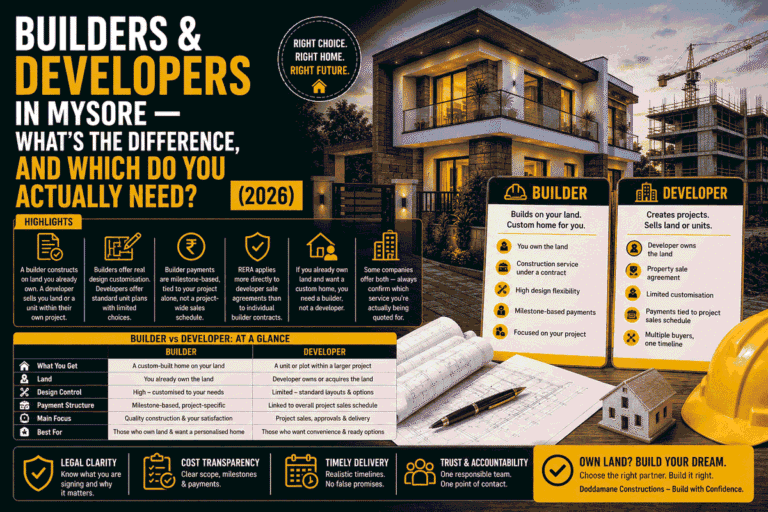
Related reading: How to Choose a Builder in Mysore and Construction Agreement in Mysore — What to Check
Frequently Asked Questions
What does a civil contractor do in commercial construction?
A civil contractor handles the structural and site work on a commercial building: excavation, foundation, the RCC framework of columns, beams and slabs, masonry, and waterproofing. This is distinct from finishing contractors, who handle interiors, and MEP contractors, who handle electrical, plumbing, and mechanical systems.
How do I verify a civil contractor’s license and registration in Mysore?
Ask directly for their business registration and GST number, and cross-check the business name against GST portal records. Legitimate civil contractors in Mysore will provide this without resistance; hesitation on this point is a genuine warning sign.
What is the difference between a civil contractor and a general or turnkey contractor?
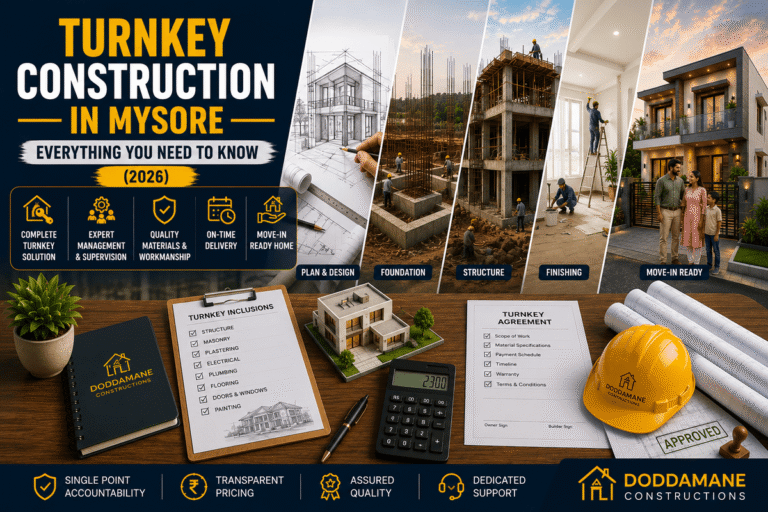
A civil contractor typically handles only the structural shell of a building. A general or turnkey contractor manages the entire project, civil work, finishing, and MEP, under a single contract and a single point of accountability.
How much do civil contractors charge in Mysore for commercial projects?
Commercial civil contracting costs vary significantly based on structural complexity, site conditions, and material specifications, so a reliable figure requires a project-specific quote rather than a general number. [Please verify current commercial rate ranges before publishing if a cost figure is required.]
Is GST registration mandatory for civil contractors in Mysore?
Yes. Any civil contractor operating as a registered business providing construction services above the applicable turnover threshold is required to hold GST registration, and a legitimate contractor should be able to produce this on request.
Do civil contractors handle MUDA or MCC approvals for commercial projects?
Some do and some do not. It is worth asking directly during vetting, since a contractor without commercial approval experience may either slow your timeline or hand that responsibility back to you without warning.