Documents Required for House Construction in Mysore — The Complete 2026 Checklist
Highlights
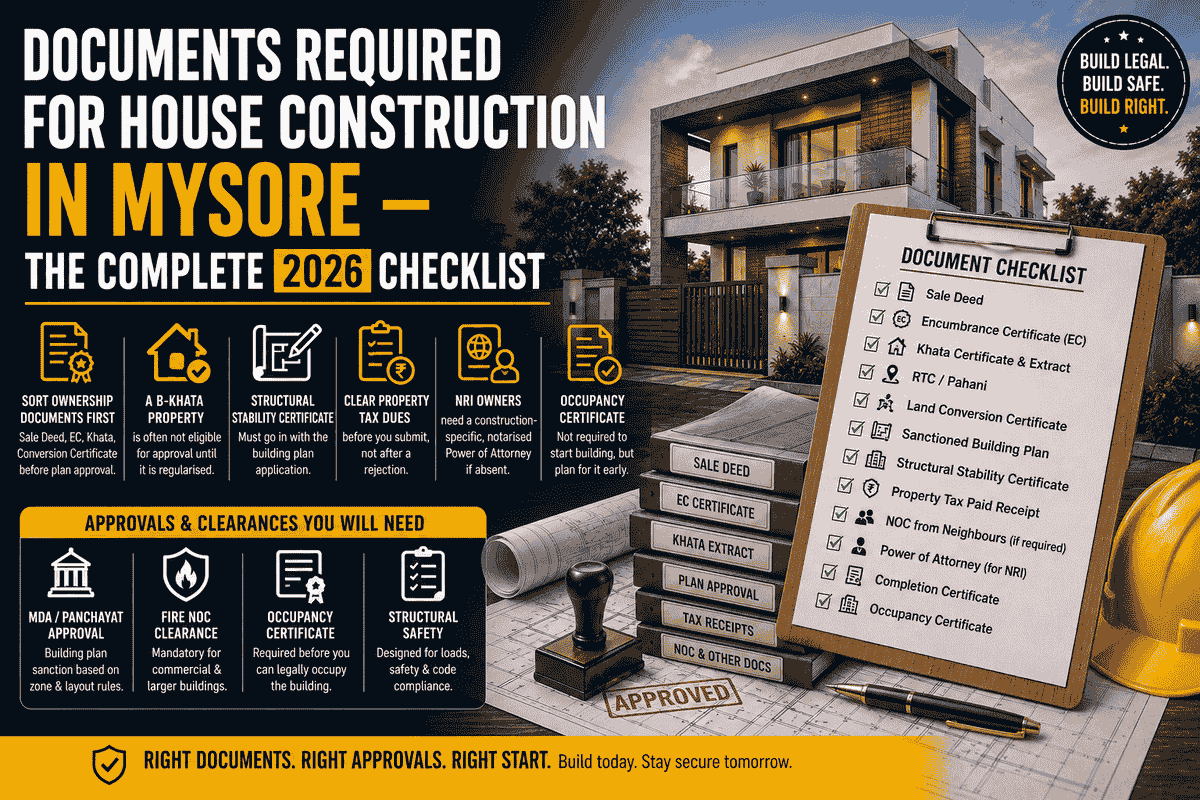
- Sort ownership documents first, Sale Deed, EC, Khata, conversion certificate, before applying for a building plan.
- A B-Khata property is often not eligible for approval until it is regularised.
- The structural stability certificate must go in with the building plan application, not after.
- Clear property tax dues before you submit, not after a rejection.
- NRI owners need a construction-specific, notarised Power of Attorney if they cannot be present.
- You do not need the Occupancy Certificate to start building, but plan for it from day one.
Before a single foundation trench is dug, there is a stack of paperwork that decides whether your house construction is legal or a future demolition notice waiting to happen. Most homeowners in Mysore find out what they actually needed only after MDA or the Panchayat rejects their plan approval, or worse, after construction has already started.
This checklist covers the documents required for house construction in Mysore, in the order you are likely to need them, from proving you own the land to getting the final go-ahead to move in.
Why Getting the Papers Right Matters Before You Build
A missing or incorrect document does not just cause a delay at the approval counter. It can mean a stop-work notice after your foundation is already poured, a bank refusing to release a construction loan, or a buyer walking away when you eventually try to sell.
In Mysore specifically, plots that started as agricultural land or fall under Panchayat jurisdiction need extra documentation that a straightforward MDA layout plot does not, so the checklist is not always identical for every homeowner. A plot inside an approved MDA layout with a clean A-Khata will generally move through approval faster than a converted agricultural plot on the city’s outskirts, and it helps to know which category your plot falls into before you set expectations on timeline.
The honest starting point is this: gather every document below before you approach an architect or a builder for a sanctioned plan, not after.
The order matters too. Ownership and land-status documents (Sale Deed, EC, Khata, conversion certificate) need to be sorted first, because the sanctioned building plan application depends on them being correct. Trying to fast-track a plan approval while ownership documents are still being corrected is the single most common reason homeowners end up waiting months longer than expected.
The Document Checklist
1. Sale Deed
The Sale Deed is the primary legal proof that you own the land. It should be registered at the local sub-registrar’s office and should match the property description exactly, survey number, extent, and boundaries. Any mismatch here creates problems at every later stage.
2. Encumbrance Certificate (EC)
The EC proves the property is free of legal or financial liabilities, mortgages, unpaid loans, or ongoing disputes, typically covering the last 13 years. Lenders will not sanction a construction loan without a clean EC, and MDA will not process a plan approval on a property with an unresolved encumbrance.
3. Khata Certificate and Khata Extract
The Khata is the property’s record in the local municipal or panchayat tax rolls, and it establishes who is liable to pay property tax on the plot. In Karnataka, this distinction matters, a property with an A-Khata is generally eligible for a building plan sanction, while a B-Khata property often is not until it is regularised. [Please verify current A-Khata/B-Khata eligibility rules with MDA/MCC before publishing, as regularisation policy changes periodically.] If you are still evaluating a plot to purchase, checking its Khata status before you make an offer will save you from discovering a regularisation problem after the sale is already registered.
4. RTC (Record of Rights, Tenancy and Crops) or Pahani
If the plot was originally agricultural land, you will need the RTC or Pahani extract showing the land’s revenue history. This document is also central to proving the land was legally converted before residential construction began. Sellers do not always retain this paperwork carefully, so it is worth requesting the original RTC history rather than accepting a summary or photocopy from a broker.
5. Land Conversion Certificate (DC Conversion)
Land that was agricultural must be formally converted to residential or non-agricultural use before you can build on it. The conversion order, usually issued by the Deputy Commissioner’s office, should be checked and kept with your file even if the seller already handled it, because MDA will ask for it directly, and a missing original often means requesting a certified copy, which adds weeks to your timeline.
6. Sanctioned Building Plan
This is the approved construction plan from MDA (for city-limit plots) or the relevant Gram Panchayat (for plots outside MDA jurisdiction), confirming your layout, setbacks, and floor plan meet local building bye-laws. Construction without this approval is one of the most common reasons homeowners in Mysore receive a stop-work notice. Approval timelines vary depending on plot category and current application volume at the local office, so it is worth applying as early as your ownership documents allow rather than waiting until you are ready to break ground.
7. Property Tax Paid Receipts
Recent property tax receipts confirm there are no outstanding dues on the plot. Authorities and lenders both check this, and unpaid tax arrears can hold up plan approval even when every other document is in order, so it is worth clearing any pending dues before you submit rather than after a rejection.
8. Structural Stability Certificate
For most residential builds, particularly anything G+1 or taller, you will need a structural stability certificate from a licensed structural engineer confirming the design can safely bear the intended load. This is submitted alongside your building plan application, and it should come from a licensed structural engineer whose registration MDA will independently verify, not simply a signed drawing from your contractor.
9. Identity and Address Proof of the Owner
Aadhaar, PAN, and address proof of every person named on the title are required at multiple stages, from the plan sanction application to loan disbursal. Keep certified copies ready rather than scrambling for them at each office visit, and if the property is jointly owned, every co-owner’s documents will be required, not just the primary applicant’s.
10. Occupancy Certificate (at completion)
This is not needed to start construction, but it is worth planning for from day one. The Occupancy Certificate, issued after construction is complete and inspected, is what legally allows you to move in and is required if you ever want to sell, mortgage, or get a water and electricity connection regularised.
Quick Reference Table
| Document | What It Proves | Typically Issued By |
| Sale Deed | Legal ownership of the land | Sub-Registrar’s Office |
| Encumbrance Certificate | No pending loans, mortgages, or disputes | Sub-Registrar’s Office |
| Khata Certificate / Extract | Property tax liability record; A/B Khata status | MCC / Gram Panchayat |
| RTC / Pahani | Revenue history for originally agricultural land | Revenue Department |
| Land Conversion Certificate | Agricultural land legally converted for residential use | Deputy Commissioner’s Office |
| Sanctioned Building Plan | Layout, setbacks, and floor plan meet building bye-laws | MDA / Gram Panchayat |
| Property Tax Receipts | No outstanding dues on the plot | MCC / Gram Panchayat |
| Structural Stability Certificate | Design can safely bear intended load | Licensed Structural Engineer |
| Occupancy Certificate | Construction complete, inspected, legal to occupy | MDA / Gram Panchayat |
Common Delays Caused by Missing or Incorrect Documents
The single most common hold-up we see is a Khata that has not been updated to reflect the current owner, which stops a plan approval application before it even gets reviewed. The second most common is an incomplete or missing land conversion certificate on plots that were agricultural within the last decade, something buyers frequently assume the previous owner handled, without ever confirming it.
A less obvious delay comes from mismatched survey numbers or extent between the Sale Deed, the Khata, and the RTC. Even a small discrepancy, a boundary measurement off by a few feet, can require a fresh survey and correction before MDA will proceed. It is worth reconciling all three documents against each other before you submit anything.
Structural stability certificates cause a different kind of delay. Homeowners sometimes commission this only after their building plan is submitted, when it should be arranged alongside the plan itself, since MDA will not sanction a G+1 or taller structure without it attached to the same application.
How Long Should You Budget for This
If every document is already in order, an MDA plan approval on a straightforward residential plot typically takes a few weeks once submitted. In practice, most homeowners take longer, not because approval itself is slow, but because gathering and correcting documents, an outdated Khata, a missing conversion certificate, a survey mismatch, happens in parallel with the application rather than before it.
A realistic approach is to treat document verification as its own project phase, separate from architectural design. Start it the moment you finalise the plot purchase, well before you are ready to finalise a floor plan, so that by the time your design is ready, the paperwork is not the thing holding up submission.
How Doddamane Handles This for Clients
For clients who choose our turnkey construction service, document verification happens before we finalise a construction agreement, not after. We review the Sale Deed, EC, Khata, and conversion status upfront, flag anything that needs correction, and only then move to the sanctioned plan application. This is part of why our clients rarely experience the mid-construction stop-work delays that come from paperwork issues discovered too late. [Please verify whether Doddamane offers document verification as a standalone service or only as part of full turnkey engagement before publishing.]
If you are still at the plot-buying stage, getting this checklist right before you sign anything will save you significant time once construction is ready to begin.
See the full Doddamane turnkey construction process for how document verification fits into the overall build timeline.
If You Are Building From Outside India
For NRI clients building in Mysore, the same document list applies, with one addition: if you cannot be physically present for registration or approval steps, a Power of Attorney (POA) authorising a trusted representative, usually a family member, needs to be executed and, in most cases, notarised at an Indian consulate. Banks and MDA both require the POA to specifically mention construction and property-related authority, a generic POA is often rejected. [Please verify current POA notarisation and consular attestation requirements before publishing, as these vary by country of residence.]
It is worth having your representative confirm every document on this checklist independently rather than relying on a builder or agent’s word, since correcting an error remotely takes considerably longer than catching it early.
Related reading: Building Plan Approval in Mysore — MDA/Panchayat Guide and Construction Agreement in Mysore — What to Check Before You Sign, both already live on the site.
Frequently Asked Questions
What documents are required to start house construction in Mysore?
At minimum, you need the Sale Deed, Encumbrance Certificate, Khata Certificate, proof of land conversion if applicable, property tax receipts, and a sanctioned building plan from MDA or the relevant Panchayat before construction can legally begin.
What is the difference between A-Khata and B-Khata in Karnataka?
An A-Khata property is fully compliant with local building and revenue regulations and is generally eligible for a building plan sanction. A B-Khata property has some irregularity, often related to conversion or layout approval, and typically needs to be regularised before construction can be approved. [Please verify current regularisation process and eligibility criteria before publishing.]
Do I need an Encumbrance Certificate before building a house?
Yes. Lenders require a clean EC before releasing a construction loan, and it is standard practice to confirm the property has no outstanding legal or financial claims before construction begins.
Is a Land Conversion Certificate always required?
It is required if the plot was originally agricultural land. Plots that were always designated residential or fall within an approved layout typically will not need a separate conversion certificate, but this should be confirmed for your specific plot rather than assumed.
When do I need the Occupancy Certificate?
The Occupancy Certificate is issued after construction is complete and inspected. You do not need it to start building, but you will need it to legally move in, get utility connections regularised, or sell the property later.
Can construction start before the building plan is approved?
No. Starting construction before MDA or the Gram Panchayat has approved your building plan is one of the most common causes of a stop-work notice in Mysore, and any work completed before approval can be required to be demolished or modified to match the eventually sanctioned plan.