Khata Transfer in Mysore: Complete Guide for New House Owners (2026)
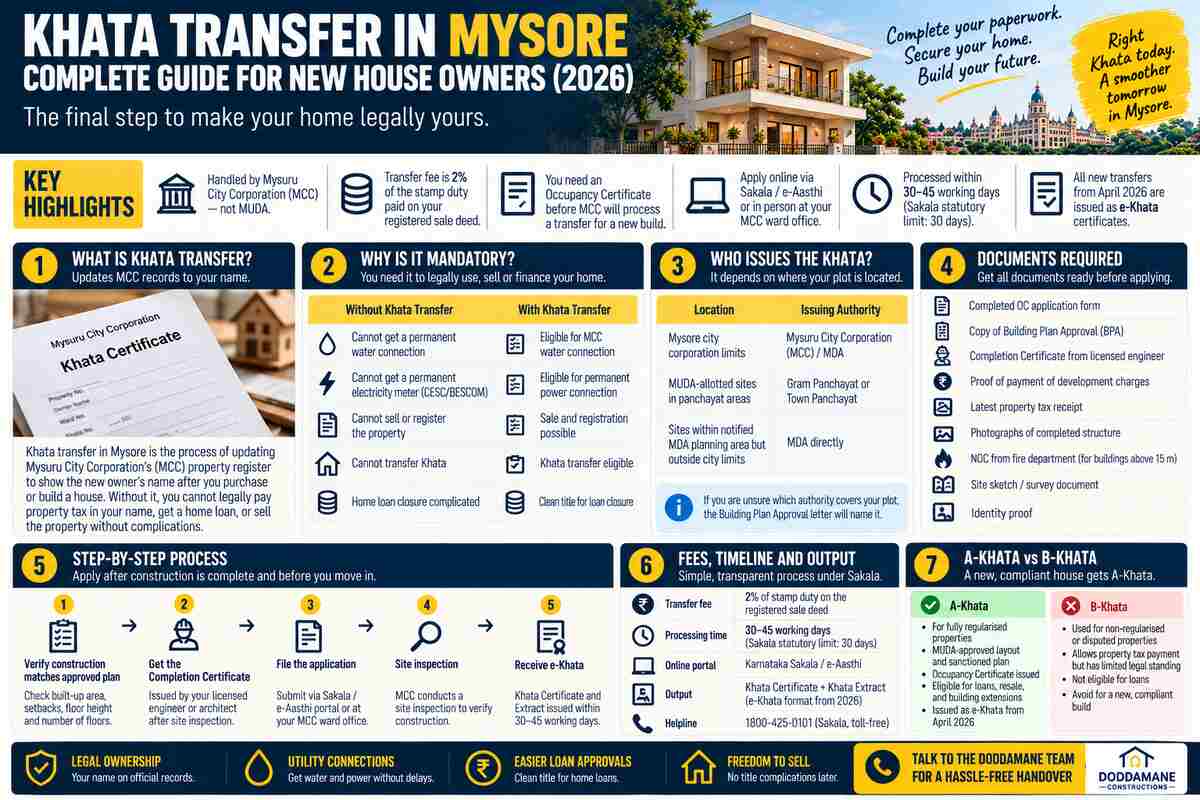
Highlights
- Khata transfer in Mysore is handled by Mysuru City Corporation (MCC) — not MUDA
- The transfer fee is 2% of the stamp duty paid on your registered sale deed
- You need an Occupancy Certificate before MCC will process a transfer for a new build
- Applications can be filed online via Sakala / e-Aasthi or in person at your MCC ward office
- MCC processes the transfer within 30–45 working days (Sakala statutory limit: 30 days)
- From April 2026, all new transfers in Mysore are issued as e-Khata certificates, downloadable from the MCC portal
- Missing documents trigger a deficiency notice and restart the 30-day clock — get all paperwork ready before applying
What Is Khata Transfer and Why Does a New House Owner in Mysore Need It?
Khata transfer in Mysore is the process of updating Mysuru City Corporation’s (MCC) property register to show the new owner’s name after a house is purchased or built. Without it, you cannot legally pay property tax in your name, get a home loan, or sell the property without complications.
When you buy or build a new house in Mysore, the Khata does not transfer automatically. The builder or previous owner held the Khata in their name. Once the sale deed is registered in your name at the Sub-Registrar’s office, you need to apply separately to MCC to transfer the Khata into yours. This is called a Khata Transfer. MCC Mysuru’s property rolls cover over 2,25,000 registered properties in the city (Star of Mysore) — making timely Khata transfer essential to avoid property tax disputes and title complications.
In Mysore, Khata transfer is processed by MCC Mysuru — not the Sub-Registrar or MUDA. After your sale deed is registered, submit your application with the OC, EC, and previous Khata to MCC. Pay 2% of the stamp duty as the transfer fee. MCC issues the Khata Certificate and Extract within 30–45 working days under the Karnataka Sakala Services Act, 2011.
Khata Transfer in Mysore — Key Facts
| Issuing authority | Mysuru City Corporation (MCC) |
| Fee | 2% of stamp duty on the registered sale deed |
| Processing time | 30–45 working days (Sakala statutory limit: 30 days) |
| Online portal | Karnataka Sakala / e-Aasthi |
| Documents needed | Sale deed, EC, OC, previous Khata, tax receipt, ID proof |
| Output | Khata Certificate + Khata Extract (e-Khata format from 2026) |
| Helpline | 1800-425-0101 (Sakala, toll-free) |
Where Does Khata Transfer Fit in the Post-Construction Paperwork Sequence?
For anyone building a new house in Mysore, the regulatory paperwork follows a set sequence after construction. Khata transfer is the final step in this chain — and it cannot be completed until the earlier steps are done.
- Building Plan Approval — sanctioned by MUDA (Mysore Urban Development Authority) before construction begins. Confirms the layout, setbacks, and floor area comply with the Master Plan.
- MUDA Site Allotment or Layout Approval — for plotted developments, MUDA approves the layout and assigns plot numbers, which become the legal reference for all future documents.
- Occupancy Certificate (OC) — issued by MUDA or the relevant authority after construction is complete and inspected. Confirms the building was built as sanctioned. Lenders require this; it is also needed for the Khata transfer.
- Sale Deed Registration — at the Sub-Registrar’s office. This is the legal transfer of ownership. The stamp duty paid here is what the Khata transfer fee is calculated on.
- Khata Transfer at MCC — once the sale deed is registered, you apply to MCC to record the new ownership in the corporation’s property register. This gives you the Khata Certificate and a Property Tax Identification Number (PTIN).
Skipping or delaying any step blocks the next. The OC is needed to support the Khata transfer application; without a Khata, you cannot pay property tax officially, refinance the property, or apply for building extensions through MCC Mysuru.
A-Khata vs B-Khata: Which One Will a New House in Mysore Get?
Karnataka local bodies maintain two types of Khata records:
A-Khata is the full, official Khata issued by MCC for properties that are fully regularised: the layout is MUDA-approved, the building plan is sanctioned, all dues are cleared, and an Occupancy Certificate has been issued. An A-Khata allows you to get building plan approvals for extensions, obtain trade licences, and take loans without complications.
B-Khata (also called the B-Register) was used for properties that existed in areas not fully brought under the corporation’s jurisdiction, or that had layout or plan irregularities. The B-Khata allowed the owner to pay property tax but did not confer full legal standing.
For a new house in Mysore built on a MUDA-approved layout with a sanctioned building plan and an Occupancy Certificate, you are eligible for an A-Khata directly. There is no reason to accept a B-Khata on a fully compliant new build.
As of April 2026, MCC Mysuru issues new transfers as e-Khata certificates — a digitised Khata linked to a LiDAR-based property survey — downloadable from the MCC portal. An A-Khata in e-Khata format carries the strongest legal standing for loans, resale, and approvals.
What Documents Are Required for Khata Transfer in Mysore?
MCC Mysuru requires the following documents for a Khata transfer on a new house. Gather all of these before applying — a single missing document triggers a deficiency notice and restarts the 30-day clock.
| Document | Notes |
| Application form | Available at MCC ward offices or downloadable from the MCC Mysuru portal |
| Certified copy of the registered sale deed | Obtained from the Sub-Registrar’s office after registration |
| Encumbrance Certificate (EC) | For the period covering your ownership; obtained from the Sub-Registrar or via Kaveri 2.0 online |
| Previous Khata details | Khata Certificate and Khata Extract in the seller’s / builder’s name |
| Occupancy Certificate | Issued by MUDA or the competent authority after completion inspection |
| Building plan approval order | The sanctioned plan from MUDA |
| Latest property tax paid receipt | Confirms no arrears on the property |
| Aadhar card (self-attested copy) | Identity proof of the new owner |
| Passport-size photographs | Typically 2 copies |
| Proof of stamp duty payment | The e-stamp or franking receipt from registration; the transfer fee is calculated on this amount |
If the property is in a layout that was converted from BBMP or a gram panchayat area to MCC jurisdiction, you may also need the conversion order. For properties in MCC limits from the outset, this is not required.
All copies should be self-attested. MCC ward offices may ask for one set of originals to verify before accepting certified copies. Mysuru leads Karnataka in e-Khata adoption: as of August 2025, the district had 1,50,671 e-Khatas (1,22,268 A-Khatas and 28,389 B-Khatas) under the e-Aasthi system (Star of Mysore) — underlining why a complete, correct document set matters for a smooth transfer.
How to Apply for Khata Transfer in Mysore: Step-by-Step (Online and Offline)
Option A: Khata Transfer Online in Mysore via Sakala / e-Aasthi
- Visit the Karnataka Sakala portal (sakala.karnataka.gov.in) or the e-Aasthi property management portal linked from the MCC Mysuru website.
- Register or log in with your mobile number.
- Select Khata Transfer under the MCC Mysuru service category.
- Enter the existing Khata number (from the seller’s Khata Certificate) and verify the property details.
- Upload scanned copies of all required documents (see checklist above). Accepted formats are typically PDF and JPEG; each file should be under 2 MB.
- Submit the application. You will receive a Sakala acknowledgement number with a 30-working-day statutory deadline.
- Pay the Khata transfer fee online via the payment gateway.
- Track your application status on the Sakala portal using the acknowledgement number.
- Once approved, download the e-Khata Certificate from the MCC portal.
Option B: In-Person at the MCC Mysuru Ward Office
- Visit the MCC ward office for the ward in which your property is located. Mysuru has 65 wards; the ward number is on your property address or the layout documents.
- Collect the Khata Transfer application form (or bring a filled copy downloaded from the MCC website).
- Submit the completed form along with self-attested copies of all required documents and originals for verification.
- Pay the transfer fee at the cash counter and collect the receipt.
- You will be given an acknowledgement slip with an expected processing date.
- Return on the given date or check the MCC portal to collect your Khata Certificate and Khata Extract.
Option C: Assisted Submission via Karnataka One / Mysore One Centres
Karnataka One and Mysore One centres accept Khata transfer applications on behalf of MCC and forward them to the relevant ward office — a convenience option for assisted submission without visiting the ward office directly.
What Is the Khata Transfer Fee and Timeline in Mysore (2026)?
Fee
The khata transfer fee in Mysore charged by MCC Mysuru is 2% of the stamp duty paid on the registered sale deed. This applies to properties within Mysuru City Corporation limits, including layouts under MUDA jurisdiction that have been brought into MCC’s property tax roll.
Example: If your sale deed carried a stamp duty of Rs. 3,00,000, the Khata transfer fee is Rs. 6,000.
Note on fee discrepancy: Some sources cite 0.5% of the property’s market value instead of 2% of stamp duty. MCC Mysuru applies the 2%-of-stamp-duty formula. Confirm the exact figure at your MCC ward office or via the MCC Mysuru portal before submitting, as rates can be revised by the corporation.
There may be a small additional charge for the Khata Extract (typically Rs. 25–100 per page).
Timeline
| Stage | Expected Duration |
| Document submission accepted | Same day (in-person) or within 2–3 days (online) |
| Sakala statutory processing deadline | 30 working days |
| Actual processing at MCC (typical) | 30–45 working days |
| Issuance of Khata Certificate + Extract | Within the above window, if no deficiency notice |
If MCC raises a deficiency notice (missing or incorrect document), the Sakala statutory clock restarts once you resubmit. Under the Karnataka Sakala Services Act, 2011, delayed processing beyond the 30-working-day deadline entitles applicants to seek escalation through the Sakala helpline (1800-425-0101, toll-free) or the Sakala portal’s grievance section.
Why Do Khata Transfer Applications Get Rejected in Mysore — and How to Avoid It?
Mysuru City Corporation has 51,682 e-Khatas within city limits — the highest e-Khata count in Karnataka, per Star of Mysore (August 2025) — as MCC digitises its entire property register under e-Aasthi. Despite this progress, rejection rates remain notable.
Six issues account for most rejections in Mysore: EC showing an undischarged home loan (get the closure letter reflected in the EC first); outstanding property tax arrears in the previous owner’s name; name spelling mismatches across sale deed, EC, and previous Khata; missing Occupancy Certificate for new builds; unsanctioned construction deviations not yet regularised; and filing at the wrong ward office.
Prevention checklist before submitting: Obtain an EC that shows no active charge, clear all property tax arrears and collect the paid receipt, confirm name spelling is identical across sale deed + EC + previous Khata, have the OC and building plan sanction order in hand, and verify your ward number from the layout or sale deed before visiting the office or uploading online.
How Doddamane Constructions Helps You Through the Paperwork Sequence
For most homeowners, the post-construction paperwork sequence — Occupancy Certificate, sale deed registration, and Khata transfer — is unfamiliar territory. Doddamane Constructions manages this sequence for the homes we build in Mysore: we coordinate the OC with MUDA, prepare the documentation set for your Sub-Registrar appointment, and guide you through the Khata transfer at MCC, including document verification and fee calculation, so the transfer is completed without a deficiency notice.
If you are planning a new home in Mysore, or have already built one and need help navigating the approvals and Khata transfer, speak with our team. We cover residential construction across Mysore and handle the regulatory paperwork from building plan sanction through to Khata issuance.
Contact Doddamane Constructions: doddamaneconstructions.com/residential
Frequently Asked Questions
Is khata transfer mandatory after buying a new house in Mysore?
Yes. While the law does not set a specific deadline for Khata transfer after registration, the Khata is the basis for MCC property tax billing. Without a Khata in your name, you cannot pay property tax officially, and you may face complications if you apply for a home loan, extension plan approval, or need to sell the property in future. MCC also levies a penalty for delayed Khata transfer in some cases.
Can I apply for khata transfer before getting the Occupancy Certificate?
For a new construction, no. MCC requires the Occupancy Certificate as proof of completed, authorised construction before it will transfer the Khata on a newly built house. The OC must be obtained from MUDA (or the competent authority) first.
How do I do khata transfer online in Mysore?
Khata transfer online in Mysore is available through the Karnataka Sakala portal (sakala.karnataka.gov.in) and the e-Aasthi property management system linked from the MCC Mysuru website. Upload all required documents, pay the fee online, and track progress via your Sakala acknowledgement number. Once approved, the e-Khata Certificate is available for download from the MCC portal. Note: some ward offices still require in-person verification of originals for new builds — check with your ward before submitting online only.