How to Identify the Best Builder in Mysore for Your Project (2026)
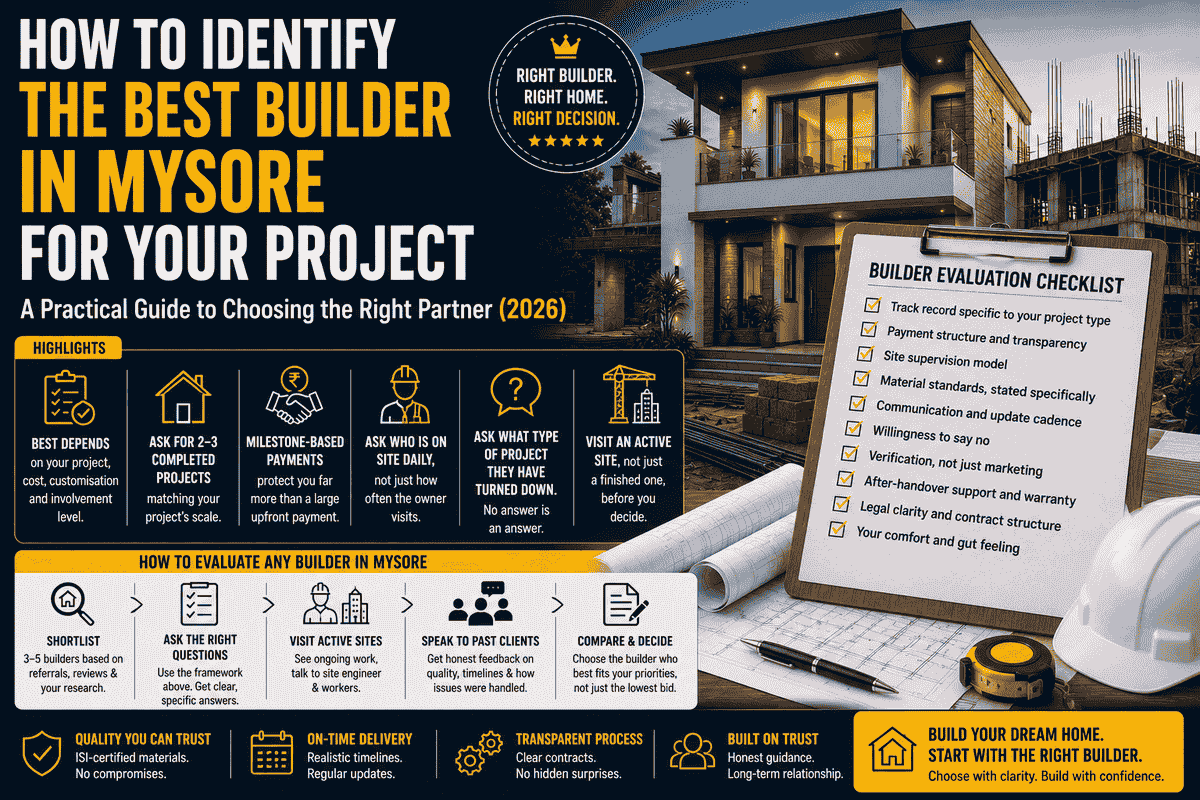
Highlights
- “Best” depends on your project, cost, customisation, and involvement level all point to different builders.
- Ask for 2-3 completed projects matching your project’s scale, not a general portfolio.
- A milestone-based payment schedule protects you far more than a large upfront payment.
- Ask who is actually on site daily, not just how often the owner visits.
- Ask what kind of project a builder has turned down. No answer is itself an answer.
- Visit an active site, not just a finished one, before you decide.
Searches for the best builders in Mysore usually assume there is one fixed answer. There is not. It depends on your plot, your budget, how involved you want to be in decisions, and what you actually value when something goes wrong mid-project. A ranked list of names cannot account for any of that, which is exactly why this is not one.
This is a decision framework instead, the specific things worth checking before you hire anyone, from a builder who has turned down projects that were not a genuine fit. If you want a list of established names in Mysore, our Top 10 Construction Companies guide covers that ground.
This guide covers how to evaluate whichever names you are already considering, whether you found them through that list, a referral, or your own search for the best builders in mysore for residential property specifically.
Why “Best” Depends on Your Project, Not a Ranking
A builder who is excellent for a 30×40 independent house may not be the right fit for a G+2 duplex with a tight structural timeline. A company known for handling large-scale projects smoothly may be genuinely uninterested in a small single-family home, and that mismatch shows up in how much attention your project actually gets.
The honest starting point is defining what you are optimising for. Some homeowners want the lowest realistic cost for solid construction. Others want maximum design customisation and are willing to pay for it. Others want minimal personal involvement and are looking for a builder who manages everything with limited check-ins. These are different projects requiring different strengths, and a builder who is “best” for one is not automatically best for another.
The Decision Framework
1. Track record specific to your project type
Years in business is a weak signal on its own. What matters more is whether the builder has completed projects similar to yours, in scale, style, and plot type, recently. Ask specifically for two or three completed projects that match your project’s size and complexity, not just their general portfolio.
If you are evaluating builders for a residential property specifically, ask whether their recent work has actually been residential, since a company that primarily builds commercial spaces may apply the wrong standards and timelines to a home.
2. Payment structure and transparency
A milestone-based payment schedule, where you pay as verified progress happens, protects you far more than a large upfront payment followed by vague instalments. Ask exactly how payments are structured and what triggers each one. A builder who is vague here, or pushes for a large advance before meaningful work has started, is telling you something about how the rest of the relationship will go.
Ask specifically what percentage is due at each stage, foundation, structure, roofing, finishing, and compare that breakdown across every builder you are considering, since the stages themselves are rarely identical between companies.
3. Site supervision model
Ask directly how often a site engineer or supervisor is actually present, not just how often the owner or salesperson visits. Daily supervision catches problems, cracked shuttering, incorrect rebar spacing, poor curing, while they are still cheap to fix. Weekly or occasional supervision means many of these issues get discovered only after they are already built in.
It is worth asking who specifically will be on site daily, a dedicated site engineer, a rotating supervisor, or the same labour contractor overseeing their own work, since each carries a different level of independent quality checking.
4. Material standards, stated specifically
A builder who can tell you the exact steel grade, cement type, and brand standards they use, without hesitation, is one who is actually tracking material quality on site. Vague answers like “good quality materials” without specifics are a signal that this is not being closely monitored.
5. Communication and update cadence
Ask what updates you will actually receive during construction, and how often. A builder who commits to a specific cadence, weekly photos, a defined check-in schedule, is setting an expectation they can be held to. One who says “we will keep you informed” without specifics usually means updates happen when you remember to ask.
6. Willingness to say no
This is the least obvious criterion and often the most revealing. Ask a builder directly what kind of project they would turn down, or ask about a time they said no to a client’s request. A builder who has no answer, who claims they say yes to everything, is either inexperienced or not being straight with you. Every experienced builder has walked away from a mismatched budget, an unsafe shortcut, or an unreasonable timeline demand.
If they cannot name one, that itself is information. This matters more than it might initially seem, a builder who agrees to every request, including ones that compromise structural safety or long-term durability, is optimising for winning your project today, not for how the home holds up ten years from now.
7. Written agreements with defined scope
Everything discussed above, payment structure, supervision commitments, material standards, should be in the written construction agreement, not left as a verbal understanding. A builder who is reluctant to put specifics in writing is asking you to trust promises that are not enforceable.
Quick Reference Table
| What to Check | Why It Matters | Red Flag |
| Track record with similar projects | Confirms real, relevant recent experience | Only generic or unrelated portfolio shown |
| Payment structure | Limits your financial exposure | Large upfront payment demanded |
| Site supervision frequency | Catches issues while still cheap to fix | Vague on who is actually on site daily |
| Material standards | Determines structural integrity & lifespan | Cannot name specific grades/brands |
| Communication cadence | Sets an expectation you can hold them to | “We’ll keep you informed” with no specifics |
| Willingness to say no | Shows consistent standards under pressure | Claims to never turn down a project |
| Written agreement | Makes commitments enforceable | Reluctant to put specifics in writing |
Set a Realistic Budget Before You Start Comparing
One of the most common reasons homeowners struggle to identify the best builders in Mysore for their situation is comparing quotes before establishing what realistic quality construction actually costs in the current market. Without that baseline, every quote looks reasonable in isolation, and the comparison becomes about price alone rather than what each price actually includes.
Before requesting quotes, get a general sense of the going rate for the quality level you want, ISI-certified materials, proper structural design, professional finishing, so you can immediately spot a quote that is unrealistically low or a builder overcharging without justification.
A builder who explains their pricing in detail, material by material, is giving you the information needed to make this comparison properly. One who resists breaking it down is not.
How to Actually Vet a Builder, Step by Step
- Visit an ongoing project, not just a completed one. A finished home tells you about the end result, but an active site tells you about process, how organised it is, whether safety practices are visible, whether the work in progress looks careful or rushed.
- Talk to at least one past client directly, not just a reference the builder hand-picked. If possible, ask the builder for a client whose project had some kind of hiccup along the way, a delay, a design change, a budget adjustment, and ask how it was handled. How a builder manages problems tells you more than a project that went perfectly.
- Request a written quote that breaks down cost by category, not a single lump-sum figure. A detailed breakdown, structure, finishing, electrical, plumbing, is harder to pad with hidden margins and easier to compare across builders on an apples-to-apples basis.
- Ask about your specific project’s constraints directly, plot shape, soil type if known, any structural requirements, and listen for whether the answer is specific to your situation or a generic response that could apply to any project.
Common Mistakes When Choosing a Builder
- Treating the lowest quote as the deciding factor without asking why it is lower. A significantly cheaper quote usually means a corner is being cut somewhere, material grade, labour quality, or supervision frequency, and that difference becomes your problem well after the contract is signed.
- Assuming a builder with a larger, more polished portfolio is automatically more capable for your specific project. Scale and fit are different things. A company built around larger commercial-style projects may not bring the same attention to a modest independent house that a smaller, dedicated residential builder would.
- Skipping the site visit entirely and deciding based on photos and conversations alone. Photos show the best angle of the best result. An active site visit shows you the everyday reality of how a builder actually works.
- Not asking how to choose a builder in mysore differently based on your own involvement preference. Homeowners who want to be closely involved in decisions need a builder genuinely comfortable with frequent questions and change requests. Homeowners who want to hand off decision-making entirely need a builder who proactively communicates without being prompted. Hiring a builder whose working style does not match how you actually want to be involved creates friction regardless of their construction quality.
How Doddamane Fits This Framework
We built our process around most of what is listed above because we have seen what happens when it is skipped, milestone-based payments, daily site engineer presence, ISI-certified materials we can name specifically, and a written agreement before any work starts. This framework is also how we would want a client evaluating us to look, not just take our word that we are among the best builders in Mysore, but check each point directly.
On the “willingness to say no” point specifically, this is not theoretical for us. We have turned down projects where a client’s budget did not realistically match the quality standard we build to, because agreeing would have meant becoming a different kind of company than the one we set out to be. If a builder you are evaluating cannot describe a similar decision, it is worth asking why.
Related reading: Construction Agreement in Mysore — What to Check Before You Sign & How Doddamane’s Milestone Payment System Protects Homeowners.
See the full Doddamane story on why we approach projects this way.
Frequently Asked Questions
How do I find the best builder in Mysore for my specific project?
Start by defining what you are optimising for, cost, customisation, or minimal involvement, then evaluate builders against specific criteria: track record with similar projects, payment structure, site supervision frequency, and material transparency, rather than relying on a general reputation or a ranked list.
What questions should I ask before hiring a builder?
Ask for two or three completed projects similar in scale to yours, how payments are structured and what triggers each instalment, how often a site engineer is present, and what specific material standards they use. Also ask about a project or request they turned down, and why.
Is the cheapest quote usually the best option?
Not reliably. A significantly lower quote usually reflects a reduction somewhere, material grade, supervision frequency, or labour quality, that is not visible in the quote itself but becomes apparent during or after construction.
How important is it to visit an ongoing construction site before hiring?
It is one of the most useful steps available to you. A finished home shows the end result, but an active site shows process, organisation, and whether work in progress looks careful, information a portfolio of photos cannot give you.
Should I be concerned if a builder says they never turn down projects?
It is worth asking about directly. Every experienced builder has encountered a mismatched budget, an unsafe shortcut request, or an unreasonable timeline at some point. A builder with no example of saying no may be inexperienced, or may not be applying consistent standards.
What is the difference between choosing a builder for a residential project versus a commercial one?
Residential projects generally need closer attention to individual family requirements and a more flexible, personal working relationship, while commercial projects prioritise scale and standardised process. A builder skilled at one does not automatically bring the right approach to the other, so it is worth confirming recent, relevant experience specifically in whichever category matches your project.