
Common Delays in Mysore Home Construction — What Actually Causes Them and How Doddamane Avoids Them (2026)
Highlights of the blog:
- Five real causes behind most home construction delays: material delivery, approval backlogs, monsoon, labour availability, and mid-construction design changes.
- MDA plan approval in Mysore typically takes 45-90 days, and delays usually trace back to incomplete documentation, not a slow process.
- Monsoon overlap on foundation or roofing work can add two to four months to a schedule, this one is managed around, not eliminated.
- Skilled labour is a shared citywide resource, and availability tightens during festival and harvest seasons.
- Homeowners cause some of their own delays too: late documents, undecided designs, and slow responses to builder questions.
- Doddamane runs a specific, named process against each cause rather than promising a blanket on-time guarantee.
Almost every homeowner asks a builder some version of “will my project be on time,” and almost every builder says yes. Home construction delays are still the single most common complaint against builders in Mysore, which tells you how much that yes is usually worth.
This post skips the reassurance and names the actual causes instead, material delivery, approval backlogs, monsoon, and labour availability, along with the specific process control Doddamane runs against each one. If a cause can’t be fully eliminated, we say so, and explain what actually reduces it instead of promising it away.
Why We’re Naming the Causes Instead of Just Promising “On Time”
A builder who claims delays never happen on their projects is either exaggerating or hasn’t built enough homes to have seen one yet. Home construction delays happen for real, identifiable reasons, most of which are at least partly manageable and a few of which genuinely aren’t.
Naming them honestly, the way we’ve done with our own project selection criteria before, is more useful to a homeowner than a blanket promise that sounds reassuring right up until it isn’t true.
This isn’t a uniquely Mysore problem either, poorly controlled causes like these are expensive everywhere. Industry data puts the average construction dispute worldwide at $60.1 million and roughly 12.5 months to resolve, numbers that show how much a preventable cause compounds once it’s left unmanaged, even if your own project is a fraction of that scale.
Cause 1 — Material Delivery Delays
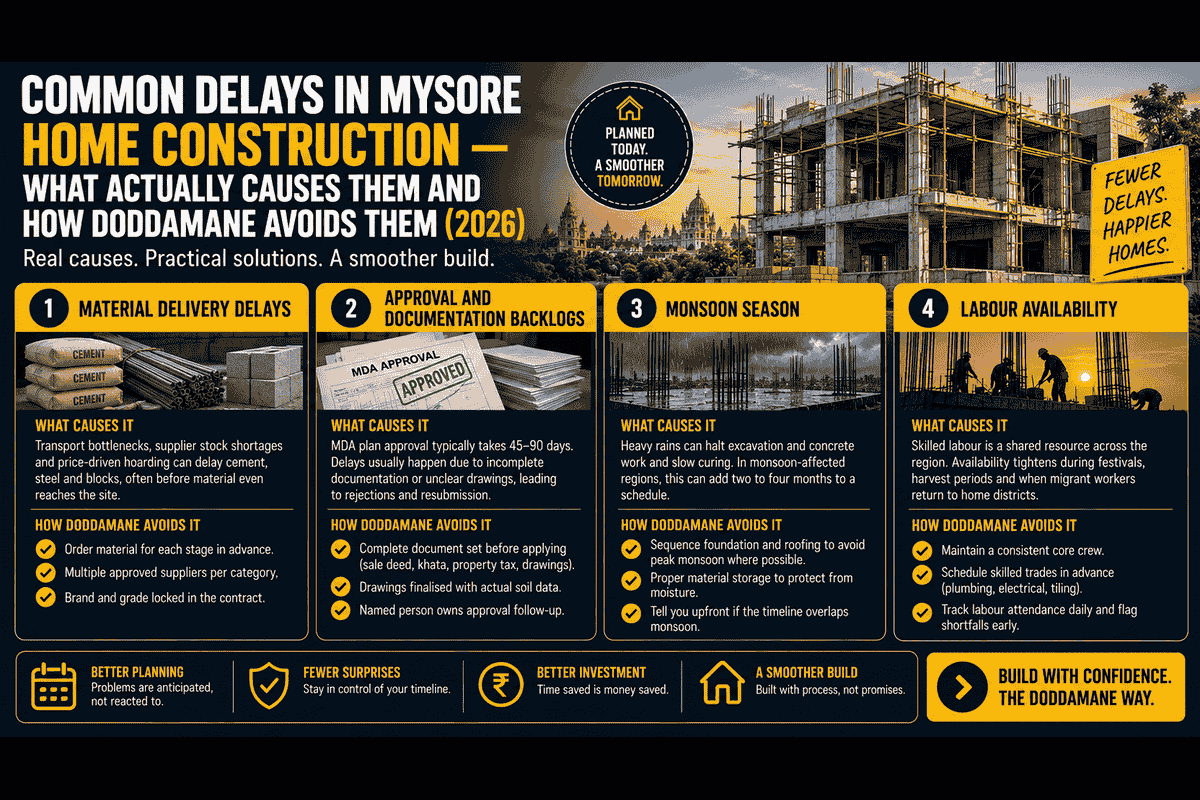
Material delivery issues are among the most common construction delays mysore causes trace back to, and most of it happens upstream of the site. Cement, steel, and blocks all move through a supply chain that can slow down for reasons that have nothing to do with the builder, transport bottlenecks, supplier stock shortages, and price-driven hoarding during high-demand periods.
- We order material for a stage before that stage actually starts, not the week it’s needed.
- We work with more than one approved supplier per material category, so one supplier’s stock issue doesn’t stall the site.
- Material brand and grade are locked in the contract upfront, so a delivery delay never turns into a quiet substitution.
Cause 2 — Approval and Documentation Backlogs
MDA plan approval in Mysore typically takes 45 to 90 days, and delays here almost always trace back to incomplete documentation on first submission rather than the approval process itself being slow. A missing khata copy or an unclear structural drawing sends the whole application back to the queue.
- We assemble the complete document set, sale deed, khata, property tax receipts, and structural drawings, before applying, not after a first rejection.
- Structural drawings are finalised against actual soil data before submission, so revisions aren’t needed mid-review.
- A named person owns approval follow-up, so the application isn’t sitting untracked in a queue.
Cause 3 — Monsoon Season
This is one of the house building delays that isn’t really fixable, only manageable around. In monsoon-affected regions, foundation or roofing work that overlaps the rainy season can add two to four months to a schedule, since rain halts excavation and concrete work and slows curing.
- Foundation and roofing stages are sequenced to avoid the peak monsoon window wherever the project timeline allows it.
- Material storage is planned to protect cement and steel from moisture damage during the season, rather than reactively covering deliveries after the fact.
- Homeowners are told upfront if a project’s timeline will overlap monsoon, rather than that risk surfacing mid-build.
Cause 4 — Labour Availability
Skilled labour, masons, shuttering carpenters, electricians, is a shared resource across every active site in a city, and availability tightens during festival seasons and harvest periods when workers return to their home districts.
Karnataka isn’t drawing from a Mysore-only labour pool either, Kerala, Tamil Nadu, and Karnataka together employ nearly 13 million migrant workers, so any regional pull, elections, festival travel, the agricultural season back home, affects site availability across all three states at once, not just one city.
- We maintain a consistent core crew across projects rather than sourcing labour fresh for each site from the open daily-wage market.
- Skilled trades, plumbing, electrical, tiling, are scheduled in advance rather than booked reactively when a stage is already ready for them.
- Labour attendance is tracked daily against the project plan, so a shortfall gets flagged and addressed the same day, not discovered a week later.
Cause 5 — Mid-Construction Design Changes
Moving a wall, adding a window, or changing a room layout after foundation work has started ripples backward through stages that are already finished. Every change like this needs the structural engineer to revisit the load path, not just the architect to redraw a floor plan.
This isn’t just a construction-site problem either, industry research attributes roughly 26% of all project rework to miscommunication alone, exactly the kind of gap a documented, signed-off change process is built to close.
- Design is finalised and signed off before foundation work begins, not treated as flexible once construction starts.
- Any requested change goes through the structural engineer first, so its downstream impact on columns, beams, or timeline is known before it’s approved, not discovered after.
- Change requests and their cost or timeline impact are documented in writing, so there’s no dispute later about what was agreed.
What Homeowners Can Do to Avoid Adding Their Own Delays
Not every delay originates with the builder or the weather. Some of the most common construction delays in Mysore actually start with the homeowner, and they’re avoidable.
- Have your documents (sale deed, khata, property tax receipts) ready before design work starts, not requested midway through.
- Finalise your design decisions, layout, fittings, finishes, before foundation work begins rather than deciding as you go.
- Respond to approval or decision requests from your builder within a few days, since a pending client decision can hold up an entire stage.
- Ask your builder directly which of these five causes is most likely to affect your specific project and timeline.
How Doddamane Runs Against All Five
None of these controls exist as a standalone fix against home construction delays, they work because they’re tied to the same milestone-based, founder-led process behind every Doddamane project.
A qualified site engineer present daily catches labour and material issues the same day they happen. Milestone payments tied to verified progress mean procurement and scheduling decisions get made ahead of need, not reactively.
And a civil engineer’s sign-off on every design change means mid-construction changes get evaluated for their real impact before they’re approved, not after.
Related reading: the Step-by-Step House Construction Process in Mysore, Site Supervision in Mysore Construction, and How Doddamane Gives You 24/7 Visibility Into Your Project are all already live on the site.
See the full Why Doddamane page for the complete set of commitments behind every project we build.
Frequently Asked Questions
What causes the most home construction delays in Mysore?
The most common home construction delays trace back to five causes, material delivery issues, approval and documentation backlogs, monsoon season, labour availability, and mid-construction design changes, in roughly that order of frequency.
How to avoid construction delays Mysore homeowners commonly run into?
To avoid construction delays in Mysore, it comes down to preparation on both sides, documents ready before design starts, design decisions finalised before foundation work begins, quick responses to builder requests, and a builder who runs a specific process against material, approval, monsoon, and labour risk rather than just promising to be on time.
What are the biggest house building delays homeowners face in Mysore?
The house building delays homeowners run into most often, in roughly order of frequency, are material delivery issues, approval and documentation backlogs, monsoon season, labour availability, and mid-construction design changes.
Why does house construction get delayed even with a good builder?
Some causes of delay, like monsoon season or citywide labour shortages during festival periods, are outside any single builder’s control. A good builder manages around these rather than eliminating them, and tells you honestly which risks apply to your project.
How long does MDA plan approval take in Mysore, and why does it get delayed?
MDA plan approval in Mysore typically takes 45 to 90 days. Delays almost always come from incomplete documentation on first submission, not from the approval process itself being slow.
How much can monsoon season delay a construction project?
Foundation or roofing work that overlaps the monsoon season can add two to four months to a project timeline, since rain halts excavation and concrete work and slows curing.
Do mid-construction design changes really cause significant delays?
Yes. A change like moving a wall or adding a window after foundation work has started can require the structural engineer to reassess columns and beams already built, which ripples backward into finished stages.
Can labour shortages really delay a small residential project?
Yes. Skilled trades like masons, shuttering carpenters, and electricians are shared across every active site in the city, and availability tightens during harvest and festival seasons when workers return to their home districts.
What should I ask a builder about how they handle delays?
Ask which of the common causes, material, approval, monsoon, labour, or design changes, they consider the biggest risk to your specific project, and what specific process they run against each one, not just whether they promise to be on time.
Does Doddamane guarantee no delays?
No, and we don’t think any honest builder should. What we commit to is a specific process against each common cause of delay, and transparency with you the moment a real risk, like a monsoon overlap, applies to your project.
Are homeowners ever the cause of their own construction delays?
Yes, commonly. Late document submission, undecided design choices, and slow responses to builder questions are some of the most frequent homeowner-side causes of delay, and all of them are avoidable with early preparation.